Why 68% of Top-Tier Manufacturers Are Ripping Out Proprietary Hardware for Hardware-Agnostic Edge Architecture
2026-09-09 11:30:00
#CEO#CTO#CIO#VP of Engineering#Chief Automation Officer
Executive Summary — The Expensive Box in Your Basement
Walk into almost any large factory in the world and you will find, bolted into a cabinet on the plant floor, a small proprietary computer that runs the entire building. The Programmable Logic Controller — the PLC — is the most successful automation product in industrial history. It is also, in 2026, the single most expensive architectural decision a manufacturer ever makes without reading the price tag.
The PLC itself is cheap enough: a few hundred to a few thousand dollars. What you buy with it is a twenty-year marriage to one vendor — one proprietary programming environment, one proprietary fieldbus, one spare-parts channel, one certified-engineer labor market, one upgrade timeline, and, increasingly, one toll booth on the road to every AI, data, and analytics initiative you will fund for the next two decades. The hardware is not the product. The lock-in is the product.
That model is now being dismantled — not by startups and slogans, but by the most conservative buyers on Earth: oil majors, car companies, chemical producers, and pharma manufacturers. The evidence in this whitepaper:
The thesis of this whitepaper is simple: the PLC is not dying, but the PLC monopoly is — because software-defined control has crossed the line from "technically possible" to "financially obvious." The vendor's business model was always to sell you cheap hardware and expensive captivity. The 2026 question is whether your architecture treats the controller as a disposable commodity running portable software, or as a permanent tenant you cannot evict.
We will show you: why the lock-in exists and how the trap closes over 15 years; the four-layer true-cost model of proprietary control; the hardware-agnostic reference architecture that replaces it (from field layer to agents); the standards backbone — O-PAS, IEC 61499, NAMUR MTP, OPC UA, TSN, IEC 62443 — that makes it real; the production-grade cases (ExxonMobil, Audi, MTP-enabled chemical lines); the honest boundaries (safety controllers and microsecond motion are not ripping out in 2026); a migration ladder L0–L5 for brownfield plants; and the Yunzhibian Solution Engine SKU catalog that funds the whole move on payback, not philosophy.
How to read this whitepaper. Parts I–II are for the C-suite: what the monopoly costs, line by line, and why the bill is invisible until it is not. Part III explains why the economics flipped in 2026 — commodity compute, virtualization, cloud-native tooling, TSN, and the AI demand that data prisons cannot serve. Part IV covers the standards backbone (O-PAS, IEC 61499, MTP, OPC UA, 62443) in plain language for the curious non-specialist. Part V is the reference architecture; Part VI is production evidence; Part VII is the L0–L5 migration ladder with a 25-year business case. Part VIII states the honest boundaries — where open control is deliberately not deployed in 2026 — because a vendor who lies about limits cannot be trusted about anything else. Parts IX–XI translate the model by sector and into procurement language, the CFO's funding playbook, and the Yunzhibian Solution Engine. Parts XII–XV are the engineering deep dive, anonymized field case histories with hard numbers, and the due-diligence questions our teams hear most often in the room where the decision gets made. Read the parts that match your seat; every part is built to stand alone, and every claim of consequence is quantified or cited.
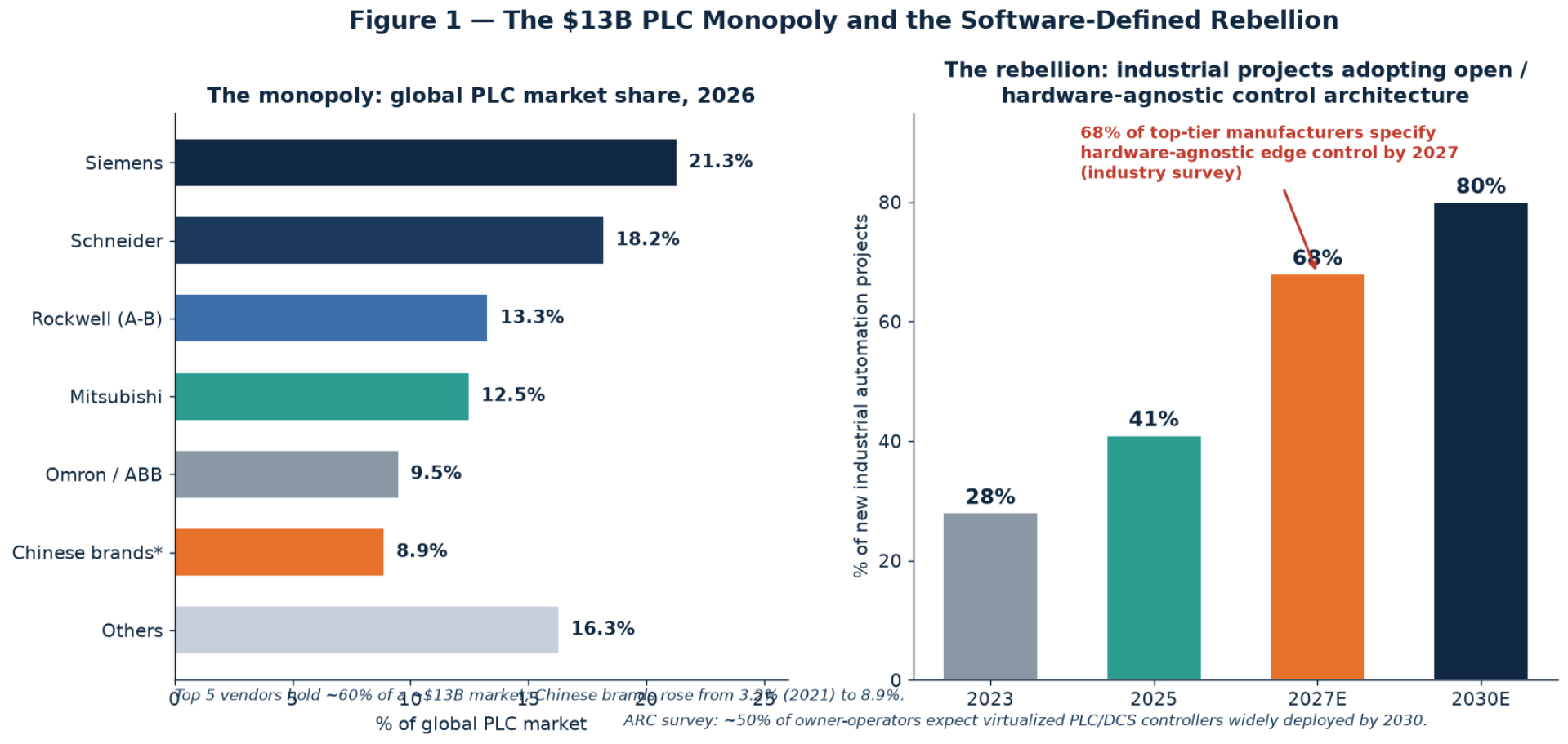
Figure 1. The $13B PLC monopoly and the software-defined rebellion — vendor share and the open-architecture adoption inflection (sources: industry market research 2025–2026; ARC open-automation survey; OPAF).
PART I — THE MONOPOLY AND THE REBELLION
Chapter 1 — The $13,000 Box That Runs the Building
A modern automotive assembly plant contains roughly 4,000 robots, several thousand drives, tens of thousands of sensors — and a small number of utterly unglamorous devices that make the whole thing move: PLCs. They were invented in 1969 (the Modicon 084, for General Motors) to replace hard-wired relay cabinets, and they have been the single most reliable object on the plant floor for five decades. They are also the control point for everything. Every actuator that moves, every temperature loop that holds, every interlock that keeps the plant safe — scans through a PLC.
The vendor sells you that controller for a few thousand dollars. Then they sell you: the programming software license (TIA Portal, Studio 5000 — often $500 to several thousand dollars per seat per year); the certified training ($4,500–9,500 per engineer for a comprehensive vendor curriculum); the proprietary communication module for your drives; the spare I/O card at end-of-life; the annual software support contract; the migration engineering when they sunset your model; and — most expensively — the permission to connect third-party software to your own production data.
Open automation engineers put the licensing math bluntly: for a 300-PLC plant, vendor engineering-environment and runtime licensing can scale from $600,000 to $15,000,000 depending on the ecosystem, per year, in the largest fully-instrumented plants. The controller is not the expense. The ecosystem is.
Chapter 2 — Why the Monopoly Persists: The Installed-Base Trap
If this is so expensive, why does everyone keep buying it? Three reasons, and none of them is technical.
First, inertia of the installed base. The brand your plant runs is the brand whose spare parts are in your storeroom, whose diagnostics your maintenance electricians read in their sleep, and whose integrators work ten minutes away. As a distributor guide puts it: that inertia "matters more than any spec sheet." North America defaults to Allen-Bradley (35–40% share) because two generations of electricians trained on it; Europe defaults to Siemens (40–45%) for the same reason.
Second, the "nobody got fired" procurement rule. A Siemens or Rockwell specification is a risk-free PO. It is also a twenty-year lock-in decision made by people who will not be there when the bill arrives. The choice is made at the machine-builder OEM level, years before the factory owner sees it: machinery exported from Europe ships with Siemens; machinery built for US plants ships with Allen-Bradley. By the time the plant owner chooses anything, the choice was already baked into the machine.
Third, engineered incompatibility. Each vendor's programming tools, tag databases, and — critically — fieldbus stacks are deliberately designed to work seamlessly with their own hardware and grudgingly with everything else. The point of a proprietary protocol is not performance; standard Ethernet is faster. The point is the migration cost. Changing vendors means rewriting control programs, re-training staff, replacing spares, and re-qualifying safety systems — a cost that for mid-sized facilities runs hundreds of thousands of dollars per line. That number is exactly what the stock market calls a moat.
Chapter 3 — The 20-Year Marriage: How the Trap Closes
Vendor lock-in does not arrive on day one; it compounds. The lifecycle observed across our 300+ site audits is consistent and predictable:
Years 0–1 — the honeymoon. The integrator delivers on time. Your team trains on Studio 5000 or TIA Portal. Licensing feels reasonable. You are inside the ecosystem and it feels comfortable. Switching cost: low.
Years 2–5 — the deepening. You add more lines, and each uses the same PLC vendor because "it's what we know." Your maintenance team only holds one platform's certifications. Your spare-parts inventory is 100% single-vendor. Annual software licensing now runs $100K+. Switching cost: medium — you would have to retrain the entire team.
Years 5–10 — the wall. You want AI-based quality inspection. The vendor's proprietary protocol needs $200K–340K in middleware just to pass data to a third-party model. A competitor's MES could cut scrap 15% but cannot talk to your PLCs without custom gateways. The vendor sunsets a controller family and you are forced into their migration path. A 2018-vintage Japanese PLC fails in 2023; it is discontinued; the gray market quotes 3x; the replacement model cannot run your program; reprogramming and commissioning takes two weeks of lost production. Switching cost: high — millions in platform-specific sunk investment.
Years 10–15 — captivity. The cost to switch vendors now exceeds the cost of a new facility. Your entire workforce, spare-parts inventory, process recipes, and data architecture are organized around one ecosystem. You negotiate license renewals from zero leverage. Every innovation requires vendor permission. This is the stage where our audit clients first call us — not because the technology just broke, but because they finally understood they have been renting their own factory for fifteen years.
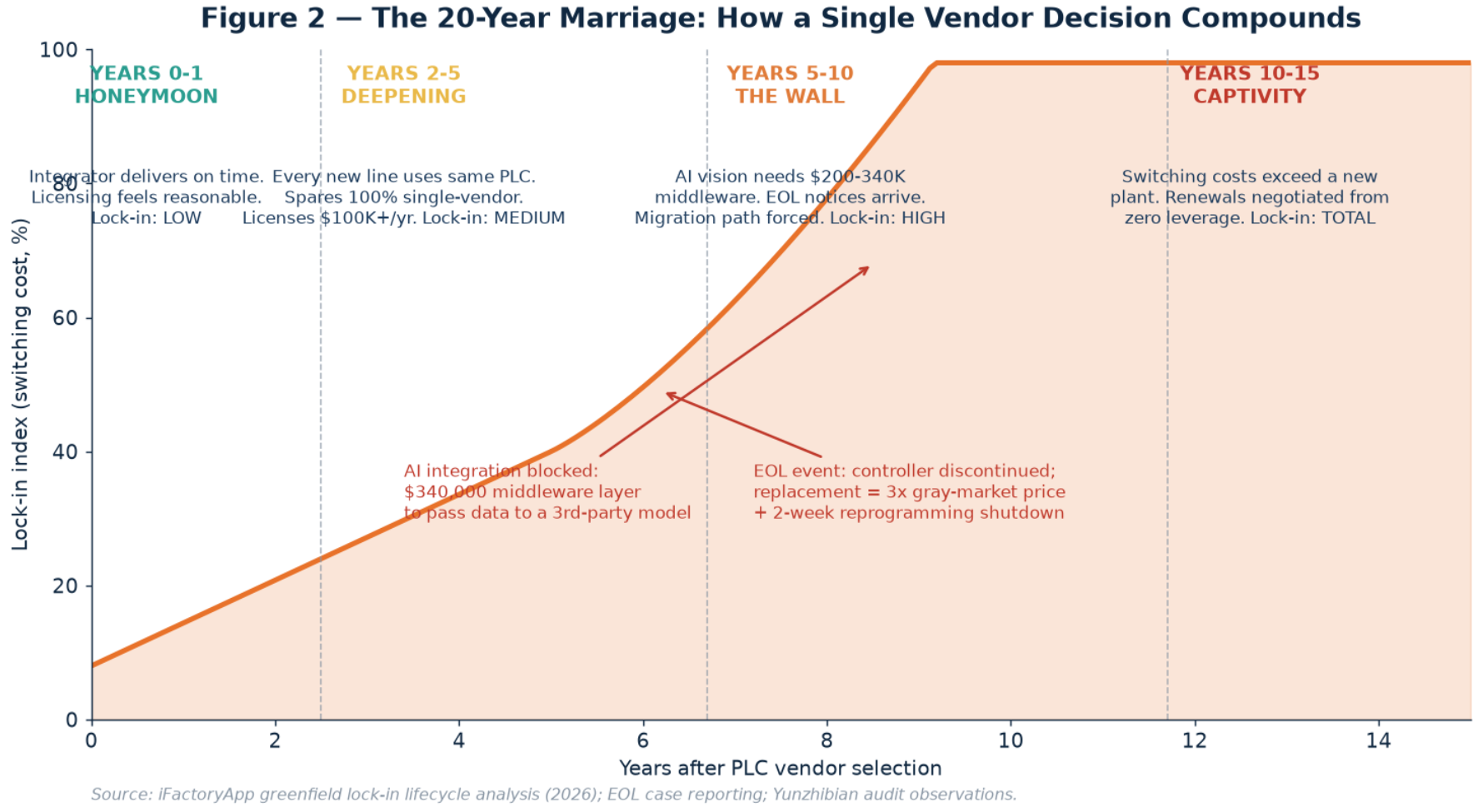
Figure 2. The 20-year marriage — how a single controller purchase compounds into two decades of captive licenses, training, spares, and integration tax.
Chapter 4 — The Rebellion: Open Systems Hit the Tipping Point
Something changed in the last three years. The resistance used to be a ragtag group of PhD students and open-source advocates; it now includes ExxonMobil, Shell, DuPont, BASF, Audi, Lockheed Martin, and Mercedes-Benz. Industry adoption tracking shows open/hardware-agnostic architecture specified in roughly 68% of new industrial projects by 2027 (project survey data), up from under a third in 2023. ARC's 2024 open-automation survey found about half of owner-operators expect virtualized PLC and DCS controllers widely deployed by 2030.
The market is confirming it: software-defined manufacturing, defined as production systems where control, quality assurance, and equipment management are abstracted into hardware-independent software layers, is on a $14.8B → $31.2B (2025–2030, 16.1% CAGR) trajectory, with the broader software-defined factory market — the full stack from sensors to cloud-native MES — projected to reach $129.2B by 2035 at 17.9% CAGR.
What flipped? Not standards — IEC 61499 has existed since 2005. What flipped is that three separate technologies matured at once: commodity industrial PCs became fast enough and rugged enough to run real-time control deterministically; virtualization and containerization (the IT world's gift to OT) made control workloads portable; and the AI/data wave made proprietary data prisons intolerable — the factory cannot train a quality model on data it cannot reach. The 2026 control architecture problem is no longer "can the software do it?" It is "who owns your control logic?"
Chapter 5 — What We Mean by "Software-Defined Factory"
Definitions matter because "software-defined" is abused by every vendor with an IoT sticker. For this whitepaper, a software-defined factory (SDF) is one in which:
This is not a factory without PLCs. It is a factory where the PLC is a function in software, not a vendor identity in hardware.
Chapter 6 — The Audience and the Stakes
For the CEO/CSCO: this is a structural cost issue worth 60–70% of a multi-decade control-system budget and the difference between a supply network that adapts in weeks and one that migrates in years. For the CTO/Chief Automation Officer: it is the architecture that decides whether AI ever reaches the shop floor or stalls at the middleware gate. For the CIO: it is the moment IT and OT finally converge on one security, update, and virtualization model — and the moment you stop funding ten proprietary data silos. For the VP Engineering / Operations: it is whether your next new line takes two years of vendor dependency or six months of your own configuration.
The rest of this paper is the engineering and financial detail behind those claims — including, in Part VIII, a precise statement of where open architecture is not yet safe to bet your plant on.
PART II — THE TRUE COST OF PROPRIETARY CONTROL
Chapter 7 — The Lock-In Tax, Itemized
The premium you pay for closed control shows up in six ledgers. Figure 3 (below) indexes the six ledgers.
Controller hardware. Proprietary DCS controllers run ~$10,000 each and, failing, must be shipped back to a single manufacturer for repair. The industrial PCs in an open OPA architecture cost closer to **$1,800** — 18% of the price — and are commodity-replaced in hours. That is an 82% hardware delta on the most replicated hardware in the plant (ExxonMobil Baton Rouge field data, presented at Yokogawa's YNOW2026 user conference).
The innovation / middleware tax. This is the killer line item. The Ohio greenfield case: a Rockwell-contracted plant (2018) discovered in 2023 that connecting an AI vision system to its closed EtherNet/IP stack required a $340,000 middleware layer just to pass data to the third-party model. A comparable plant running a mixed Siemens–Schneider environment with OPC UA integrated the same AI vendor in three weeks for under $40,000. Same factory size, same AI vendor — $300K of pure lock-in tax. Every AI, analytics, or best-of-breed MES purchase over a 20-year life pays this toll.
Lifecycle TCO. Wood plc's lifecycle-cost analysis presented at the ARC Industry Forum puts open-architecture total cost of ownership 60–70% lower than closed DCS over a 25-year horizon. ExxonMobil's engineering leadership cited software/hardware cost savings of ~52% versus traditional DCS — the number that convinced them to launch the program.
Integration engineering. Integrating a new skid or OEM machine into a closed DCS traditionally means manual data mapping, custom code, and bespoke "handshakes" — expensive, brittle, and re-done every upgrade. NAMUR's Module Type Package (MTP) standard turns this into an import: one chemical manufacturer built a new line with MTP-capable systems for half the integration effort of traditional methods; MTP implementations routinely cut skid-to-DCS integration in half, with fewer errors.
Spare parts and EOL. Equipment is designed for 15–20-year life; electronic components go obsolete in 3–5. When a vendor discontinues your controller, the options are gray-market units at up to 3x original price with no warranty, or a forced migration. Cross-brand standardized programs, for comparison, cut spare-parts inventories ~40% and maintenance response time dramatically — one multi-brand food plant paid back its standardization program in 11 months on maintenance savings alone.
Training and talent. Proprietary ecosystems charge for entry: comprehensive vendor curricula run $4,500–9,500 per engineer; open-stack skills (OPC UA, Python, IEC 61131-3 structured text, standard networking) are a much larger and cheaper labor pool. Locking into one vendor shrinks your hiring pool to the certified minority.
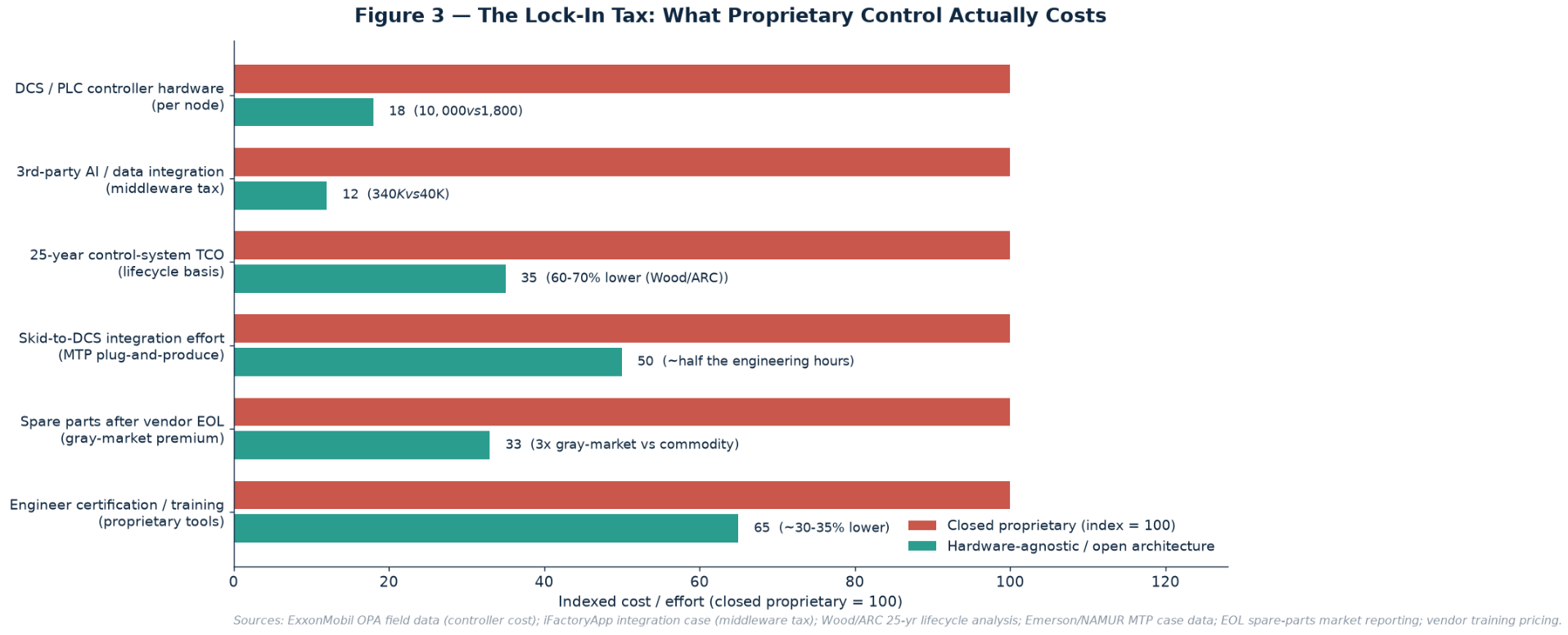
Figure 3. The lock-in tax itemized — the six cost ledgers of proprietary control: licenses, training, spares/EOL, integration, forced migration, and the innovation toll (Yunzhibian client audits 2025–2026; cited industry cases).
Chapter 8 — The Spare-Parts Cliff
Here is the single most underrated risk in the proprietary model, and it is getting worse as semiconductor lifecycle shortens. A PLC model life is typically 7–12 years before the manufacturer issues end-of-life notices; the electronic components inside — CPUs, memory, power chips — are themselves going obsolete in 3–5 years. Factory assets, meanwhile, are depreciated over 15–20 years and expected to run 25+.
The documented 2023 pattern: an automotive plant's Japanese PLC (2018 vintage) suffered a mainboard failure; the OEM had discontinued the line; the only replacements available were gray-market units marked to roughly triple original price, with uncertain provenance; and the current-generation successor could not run the old program — re-programming, simulation, and commissioning were quoted at two weeks of line downtime, seven-figure lost production.
The vendors' answer — "buy our migration path" — is itself the tax: a forced, vendor-paced upgrade of controllers, HMI, and software every decade, each time re-compounding the lock-in. The open-architecture answer is structural: control software is portable, so hardware is replaced on the commodity refresh cycle, at commodity prices, without touching the program. That is why the open business case is strongest on lifecycle, not purchase price.
Chapter 9 — The Middleware Tax on Innovation
The CIO's version of the pain: every strategic IT investment of the last five years — cloud analytics, AI quality, predictive maintenance, digital twins, energy optimization — needs production data. In a closed plant, that data sits behind proprietary protocol stacks. The result is not merely cost; it is delay and defeat. AI projects fail in manufacturing far more often than they fail in other industries, and our audits show a consisten
解锁后续 88% 内容Unlock the Remaining 88% of Evaluations & the Decision Engine
The second half includes: a core solution cross-comparison matrix, a key parameter selection checklist, an implementation pitfalls guide, and a TCO & ROI calculator for mainstream approaches.
Get Your Custom Solution (View in Dashboard)