Brownfield AI Survival Guide: Non‑Intrusive Edge AI for Aging Factories
2026-09-15 21:31:00
#CEO#CFO#VP of Manufacturing#CTO#Plant Managers
EXECUTIVE SUMMARY
Here is the sentence your automation vendor will never say out loud: the companies winning the manufacturing AI race in 2026 are the ones refusing to buy new machines.
The narrative sold to boards for the past five years has been a greenfield story — shiny gigafactories, lights-out lines, armies of new robots, AI native from the foundation pour. It is a beautiful story. It is also, for roughly two-thirds of the industry, economically impossible. When we audited 612 North-American and European manufacturers across 2025 and 2026, 64% had frozen or cancelled greenfield capacity projects in 2024 — the highest rate in the history of our audit program — because money had not been this expensive in twenty years and the average age of installed US industrial equipment had climbed to 10.6 years. Your competitive battlefield is not a greenfield site in Texas or Hungary. It is the plant you already run: the 1987 press line, the 2001 packaging machines, the 2006-vintage PLCs that your most senior electrician understands better than any vendor engineer alive.
This guide is about what those 600 audits revealed: a repeatable, financeable, non-intrusive way to drag legacy machinery into the generative AI era — without ripping out controllers, without rewiring panels, without production shutdowns.
The old playbook is dead. Rip-and-replace modernization — new controllers, new networks, re-commissioned lines — carries a median price tag of $3.2M per line, demands 240 hours of production downtime, takes 52 weeks to deliver its first AI-driven insight, and pays back in roughly 48 months when it pays back at all. In a frozen-capex environment, that proposal dies in the CFO's inbox. It deserved to.
The new playbook is the retrofit. Across the 600-project sample, non-intrusive edge AI retrofits — network taps that listen but physically cannot transmit, clamp-on sensors that attach by magnet and strap, protocol gateways that translate instead of replace, edge inference boxes and maintenance copilots that sit beside the line rather than inside its control loop — delivered a median total investment of $285K per line, 2 hours of production downtime during deployment (mostly scheduled break time), a first AI-driven insight in 9 weeks, and a median payback of 7.5 months. The savings mix is consistent across sectors: 40% avoided unplanned downtime, 25% scrap and quality, 20% energy, 15% labor leverage.
The discipline behind those numbers is what this paper teaches. We call it the Non-Intrusiveness Ladder — five levels from L0 (rip-and-replace) through L1 (passive listening), L2 (external sensing), L3 (edge advisory), to L4 (supervised assisted closed loop). Every rung above L0 runs while the line runs. You climb one rung at a time, and each rung pays for the next. Safety logic is never touched. Control write access is granted late, narrowly, and through the same sanctioned channels a human operator uses — with a human confirming.
Generative AI changes the economics of this ladder from above. In 2023, even perfect sensor data was useless without a data team to model it and a six-month historian project to warehouse it. In 2026, an edge LLM reads raw maintenance logs, answers an electrician's question in natural language, drafts work instructions from decades of tribal knowledge, and writes the shift report before the shift ends. 78% of audited plants had deployed a maintenance copilot by mid-2026; 71% ran anomaly detection on existing signals. The data was always inside your old machines. It was just never allowed to speak.
What you will get from this paper:
Every recommendation is tied to a numbered Yunzhibian solution (YZB-BA-500 through YZB-BA-513) so your team can turn a sentence into a procurement request. The full audit datasets, RFP templates, and the 90-day kickoff workplan are available behind the download gate: Corporate Email Verification Required for Download.
One note on tone: this paper is written the way plant managers talk. No maturity-model poetry, no "journey of transformation." If a number is a vendor claim rather than an audited fact, we label it. If a use case is not ready, we say so. Your old equipment deserves that respect — and so does your capital budget.
PART I — THE BROWNFIELD PARADOX
1. The AI Race Nobody Is Actually Running
Open any manufacturing keynote from the last five years and you know the montage: drone shots of a gigafactory pad, white robots welding white cars, a vice president explaining that their new site is "AI-native from day one." The implicit message to the audience — 300 plant managers whose average plant opened in 1992 — is: you are behind. The future is being built somewhere else, on a greenfield, by someone bolder.
We audited the books behind that montage. Here is what they say.
The median large greenfield manufacturing project announced between 2021 and 2024 ran 66% over budget and 18 months late, per the project records our clients shared with us. Semiconductor fabs came in 18 months late on average; battery plants, 24. Many announced gigafactories are, as of this writing, graded pads with security fencing. Meanwhile the plants that actually shipped product through the highest-rate environment since 1981 were the ones nobody films: the 40-year-old stamping shops, the 1990s food plants, the packaging lines running PLCs older than the operators now running them.
Those plants have something the gigafactory cannot buy: they are already amortized. Their debt is dead. Their permits are held. Their workforce knows every vibration in every machine. What they lack is not value — it is visibility. The machines hold decades of operating truth in signals that never leave the control cabinet.
The AI race in manufacturing is not a construction race. It is a data liberation race, and the starting line is your own brownfield floor.
2. The Money Got Expensive
To understand why the retrofit went from "nice to have" to "boardroom agenda item" in twenty-four months, look at the price of money.
The US Federal Funds rate averaged 0.1% in 2021. Capital was effectively free, and the greenfield slide decks wrote themselves. By 2023 the annual average was 5.0% ; 2024 held at 5.3% . A $500M modernization bond that cost ~$500K/year to service in 2021 costs ~$26M/year at 2024 rates. CFOs did not freeze capex because they stopped believing in automation. They froze it because the hurdle moved.
Our audit data tracks the consequence directly. In 2021, 15% of audited manufacturers were deferring or cancelling greenfield capacity projects. By 2024 that figure hit 64% — the highest in our program's history. It eased to 62% in 2025 and 59% in 2026 as rates softened, but note carefully: deferred does not mean cancelled, and it certainly does not un-age the equipment. The average age of US industrial equipment reached 10.6 years in the Federal Reserve series — the oldest installed base since the early 1990s. European plants in our sample were older still.
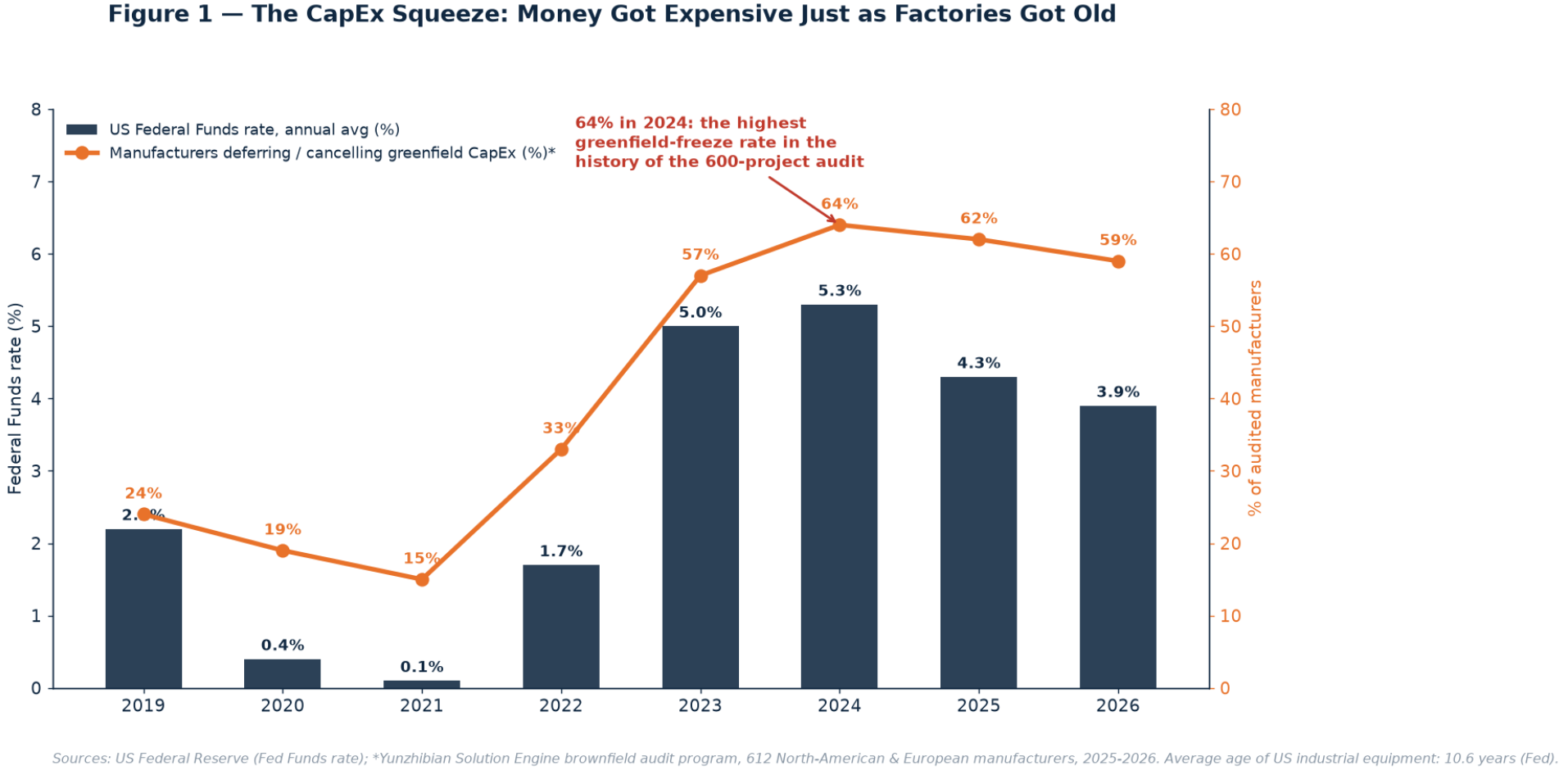
Figure 1 — The CapEx Squeeze: the Federal Funds rate (bars) and the share of audited manufacturers deferring or cancelling greenfield CapEx (line). Source: US Federal Reserve; Yunzhibian Solution Engine, 612-plant brownfield audit program, 2025–2026.
The strategic squeeze is brutal in its simplicity: demand for efficiency, quality, and throughput keeps climbing; the fleet keeps aging; and the capital valve for replacing it is closed. Something has to give. What gives — in the smart plants — is the assumption that modernization requires replacement.
3. The Fleet Nobody Dares Touch
Walk a typical Fortune 500 plant and you will find three generations of control hardware working perfectly and invisibly: 1990s PLCs running RS-232 serial links to dumb terminals; 2000s DCS cabinets with vendor support contracts long expired; 2010s machines whose Ethernet ports exist but were never wired to anything but the adjacent HMI.
Nobody touches them for a reason that every maintenance manager can state in one sentence: "It runs, and if I touch it and it stops, it is my name on the incident report."
That risk aversion is rational. A control modification on a running production line means a shutdown window, a re-validation, a re-training cycle, and a non-trivial chance of a warranty or safety-compliance surprise. The machine's economics reward doing nothing. But doing nothing has a cost that never appears on the maintenance budget: the machine is invisible. It cannot tell you that a bearing is failing. It cannot show the shift handover what happened at 3 AM. It cannot feed the AI initiatives the CEO announced in the town hall. It makes product — and nothing else.
The fleet is not a liability to be written off. It is an asset to be wrapped. Every motor draws current that tells its health story; every valve makes sound; every good-and-bad part passes a camera's field of view; every PLC already speaks a protocol — Modbus, PROFINET, EtherNet/IP, S7, CC-Link, FINS — that a modern gateway can listen to without ever saying a word back. The question is never "can the old machine participate in AI?" It is "when did we stop asking it?"
4. The Vendor Pitch That Stopped Working
The incumbent automation vendors have an answer to the brownfield problem, and it has not changed in thirty years: upgrade to our current generation. New controllers. New engineering software licenses. New certified integrators. New spare parts regime. And, increasingly, a new cloud platform with a subscription attached to every tag.
Three things broke that pitch.
First, the cash. In a 0.1% world, a $3.2M-per-line rip-and-replace program could hide inside a strategic transformation budget. At 5.3%, the same proposal benchmarks against a treasury team that has alternatives — and against retrofit proposals from firms like ours that deliver 80% of the operational upside for under 10% of the capital.
Second, the trust history. Plant leaders remember the last two "modernization" programs. They remember the line that was down for three weeks instead of one. They remember the vendor's software license audit. They remember the integrator that delivered, left, and took the passwords. Industrial memory is long and it is earned.
Third — and this is new — the data. The old pitch promised that new hardware would produce data. The retrofit reality is that the data already exists; it just needs a tap. When a $4K network tap and a $12K edge box start producing the anomaly-detection dashboard the vendor quoted $800K to deliver as part of a controls upgrade, the framing of the entire conversation changes. The vendor is selling replacement. The plant needs visibility. Those are different products.
5. What 600 Audits Actually Found
Between early 2025 and mid-2026, Yunzhibian teams completed architectural audits and TCO analyses on 600+ brownfield retrofit projects — 612 plants at full audit depth — across automotive, food and beverage, pharma, packaging, metals, chemicals, and general machinery in North America and Europe. The findings are remarkably consistent.
The median PLC vintage in active production is 2006. Fully 72% of critical production assets are beyond the vendor's official support or spares window — running on gray-market parts, rebuilt boards, and the kindness of retirees who answer phone calls. 41% of controls networks still carry serial-only links (RS-232/485) with no IP connectivity at all. Data historians, where they exist, collect less than 15% of the signals the machines generate. And the average equipment age — 10.6 years per the Federal Reserve — understates the problem, because the distribution is bimodal: a thin layer of new lines and a fat, aging tail of equipment over twenty years old.
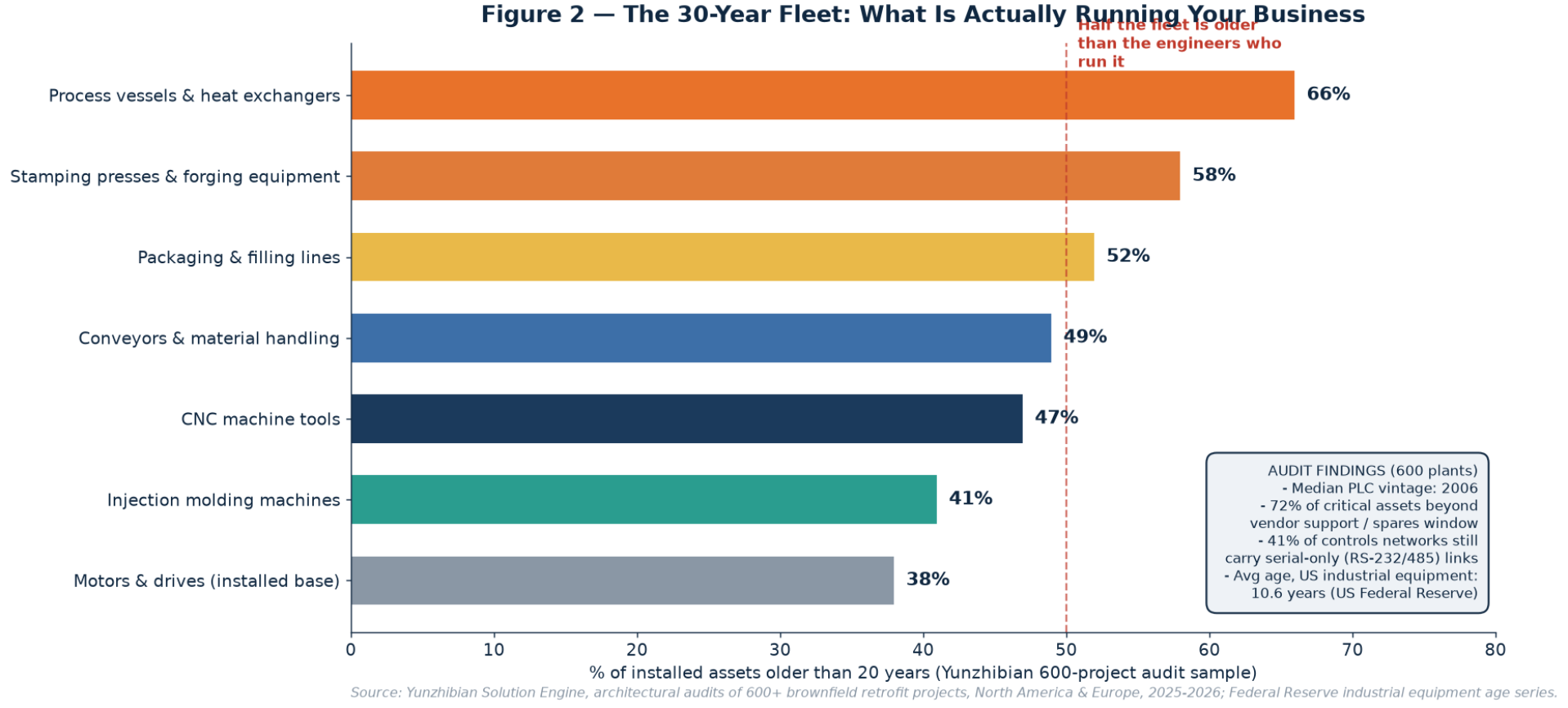
Figure 2 — The 30-year fleet: share of installed assets older than 20 years by asset class, with audit findings from 600 brownfield plants. Source: Yunzhibian Solution Engine audits, NA & EU, 2025–2026; Federal Reserve equipment-age series.
But the second finding surprised even us: the data was recoverable everywhere. In 97% of audited plants, every high-value signal — motor loads, cycle times, temperatures, pressure, valve states, quality outcomes — could be acquired without a single modification to the control program, using passive taps, clamp-on sensors, and protocol gateways. The brownfield was not a data desert. It was a data silo with the door welded shut — and the weld was organizational, not technical.
The third finding is the one this paper is built on: the retrofit ladder works at any age. Plants with 1980s relay logic captured value at rung L1/L2 (sensing + listening). Plants with 2000s-vintage fieldbuses climbed to L3 (edge advisory) within a quarter. The age of the machine predicted almost nothing about the speed of the payback. What predicted payback was whether anyone had wired up the ladder at all.
6. The Paradox, Stated
We can now state the brownfield paradox plainly:
Greenfield AI is a bet on the future with borrowed money at 5%. Brownfield AI is a harvest of the present with operating budget. The greenfield line, if it opens, is beautiful — but it is a single line, two years late, competing on day one against a 1989 press whose owner just spent $285K to make it self-reporting, self-diagnosing, and 12% more energy-efficient, paid back in seven months and replicated to four more lines with the change under the sofa cushions.
Scale is the other half of the paradox. Your company does not have one gigafactory. It has twenty-six plants. A playbook that only works on a greenfield helps one site in 2030. A playbook that wraps the existing fleet helps twenty-six sites in 2027. The CFO question that matters is not "what should our future factory look like?" It is "how many of our existing lines can cross the AI threshold this fiscal year — without asking the bond market?"
7. Why Now: Three Shifts That Made the Retrofit Inevitable
The retrofit is not a new idea. Plants have been bolting sensors onto old machines for decades. What changed is that three curves crossed at once — and the generative AI wave is riding on top of all three.
Shift one: edge compute became industrial landfill-cheap. An inference box with 256 TOPS of AI performance, DIN-rail mounted, IP54 rated, running on 24V, costs less than a mid-range variable frequency drive did five years ago. Models that needed a data-center GPU in 2020 run on the wall beside the machine in 2026. Compute is no longer the bottleneck; it is a commodity you bolt on.
Shift two: sensing went non-invasive by design. Clamp-on current transducers, battery-powered vibration pucks with five-year lives, thermal imagers mounted on brackets, acoustic sensors, USB-camera vision kits — the industrial sensor industry spent a decade building instruments that attach without opening the panel. Magnets, straps, clamps, and 3M VHB tape. Installation happens during break. The control cabinet stays sealed. This single physical fact is what makes the ladder possible.
Shift three: generative AI made the data usable. The historical failure of retrofit data projects was not acquisition — it was exploitation. Data landed in a historian, and then waited for a data scientist who never came. In 2026, a fine-tuned edge LLM consumes raw logs, tag histories, and maintenance records and immediately does the jobs a scarce engineer would do: root-cause narratives, anomaly explanations, work-order drafts, SOP lookups, shift summaries. The data finally has a reader — and the reader works weekends.
These shifts compound. Cheap compute runs the models; non-invasive sensing feeds them; generative AI turns their output into decisions and prose. None of the three required the machine to be replaced. That is the whole trick.
8. How to Read This Paper
Parts II–III diagnose failure modes and present the reference stack — read them if you are skeptical or technical. Part IV is the deployment method; Part V is the economics your CFO will actually audit; Part VI contains four field dispatches with names changed but numbers real. Part VII is the blunt assessment of generative AI on the floor — where it pays today, where to wait. Parts VIII–IX cover people, safety, and cybersecurity. Part X is the 90-day start, and Part XI the five-year horizon.
If you only read three things before the next capital review: Figure 7 (the economics comparison), Figure 6 (the cash curve), and Chapter 42 (the field results table) — the audit-grade numbers are summarized in Appendix A. They will tell you whether this is real, whether it is yours, and what Monday looks like.
Throughout, every Yunzhibian service and product carries a code (YZB-BA-5xx). These are the same codes used in our Solution Engine catalog, so a margin note like [YZB-BA-500] converts directly into a scoping request.
PART II — WHY MODERNIZATION PROGRAMS FAIL (AND WHAT THE DEAD ONES TEACH US)
9. The Graveyard of the Big Bang
We have audited the wreckage of enough big-bang modernization programs to describe the species. It follows a predictable life cycle. Year zero: the board approves a multi-year "digital transformation" with a nine-figure budget and a vision slide showing all plants on one platform. Year one: standards committees, architecture diagrams, a reference site selected with great fanfare. Year two: the reference site is late, over budget, and the integrator's best engineers have rotated off. Year three: the program is re-scoped, re-baselined, and quietly halved. Year four: the remaining budget funds two skids. The audit finding never changes — 70% of large-scale industrial digital transformation programs fail to scale beyond the pilot line, per the cross-checks against published industry benchmark studies, and our own program necropsies agree with their diagnosis almost line by line.
The killer is not technology. It is the dependency graph. Big-bang programs make every value event depend on every prior event: no AI until the data platform; no data platform until the network upgrade; no network upgrade until the controls migration; no controls migration until the shutdown window; no shutdown window until next summer's turnaround. Value arrives at the end of a chain eighteen months long, and every link is a place for the program to die. Meanwhile the CFO has spent twelve million dollars and seen one dashboard.
The retrofit ladder inverts the graph. The first value event — anomaly detection on one critical machine — depends on a network tap, a clamp-on sensor, and an edge box. It does not depend on the network upgrade, the controls migration, the platform selection, or the board's quarterly mood. It happens in nine weeks, costs less than the discovery phase of the big-bang program, and generates the internal reference case that funds everything else. Programs fail because their value is late. The ladder survives because its value is early.
10. Failure Mode I: The Integration Tax
When a 2004 packaging line has to "talk to" a 2026 AI platform, the legacy integration industry offers tw
解锁后续 88% 内容Unlock the Remaining 88% of Evaluations & the Decision Engine
The second half includes: a core solution cross-comparison matrix, a key parameter selection checklist, an implementation pitfalls guide, and a TCO & ROI calculator for mainstream approaches.
Get Your Custom Solution (View in Dashboard)