2026 OT Zero-Trust Whitepaper: Air-Gap Is Dead — Fighting NIS2 & AI Ransomware
2026-09-27 18:50:00
#CEO#CIS# CFO#VP of Operations#Chief OT Architect
Executive Summary
For twenty years the operational technology (OT) running the world's factories, utilities, and process plants has been protected by a comfortable assumption: that it is "air-gapped," physically separated from the internet and therefore out of reach of attackers. That assumption was never entirely true. In 2026 it is demonstrably false — and the cost of pretending otherwise has become existential.
Three forces have converged on the boardroom at once:
This whitepaper argues a deliberately unfashionable position: the decisive layer of OT security in 2026 is not better software but hardware-rooted isolation. The air-gap is dead as an accident of architecture — but it can be deliberately recreated, enforced in silicon, at every boundary that matters. Secure boot anchored in a hardware root of trust. Backplane isolation between zones that no compromised operating system can reconfigure. Data diodes that physically allow information to travel only one way. These guarantees survive a complete software compromise, because they are not made of software.
What the data shows
The Yunzhibian Solution Engine completed architectural security audits and incident analyses across 480+ industrial and critical-infrastructure sites in North America and Europe during 2025–2026. The findings behind this paper:
表格Finding Baseline Fortune 500 industrial sites that found their "air-gap" had a live bridge to IT/internet 75% Sites running a flat or near-flat OT network below Level 3 68% Median attacker dwell time in OT before detection 11 days Sites with an OT asset inventory accurate to within 10% 22% Organizations that can patch an OT asset without a multi-week change freeze 14% Median ransom demand against an industrial operator, 2026 $4.2M Share of OT incidents that entered through IT and moved laterally 74% NIS2 in-scope organizations assessed as "not ready" at first audit 61%
The opportunity is the same one every prior industrial transition created: the organizations that move deliberately now convert a panic-driven compliance expense into a structural advantage — measurably safer, audit-ready, and cheaper than the accumulating cost of a single event.
The reference outcome
The reference deployment in this paper — a multi-site process manufacturer — replaced its flat OT network and software-only perimeter with a hardware-rooted, zone-and-conduit zero-trust architecture. The numbers the board actually cares about:
This document explains exactly how that works, where the failures hide, and how to start a 90-day program without shutting down a single line.
How to read this whitepaper
Now the uncomfortable part.
PART I — THE AIR-GAP IS DEAD
1. The Comfortable Lie
Almost every plant tour in the world includes a variation of the same sentence. "Don't worry," the operations manager says, "the control network is air-gapped. There's no physical connection to the outside. Nothing can get in." It is delivered with the quiet confidence of someone who has never actually checked.
An air-gap means exactly one thing: no path exists by which data can move between the OT network and any untrusted network. Not a wired path. Not a wireless path. Not a path through a person, a USB drive, a contractor laptop, a vendor VPN, a dual-homed workstation, or a "temporary" bridge installed for a 2019 upgrade and never removed.
By that strict definition, genuine air-gaps have always been rare. In our 2025–2026 audits, three quarters of sites that believed themselves air-gapped had at least one live, exploitable bridge. The gap was not defeated by brilliant hacking. It was quietly abolished by convenience, one legitimate business need at a time.
2. How the Gap Actually Died
The air-gap did not collapse in a single dramatic event. It eroded through a long list of entirely reasonable decisions:
表格Bridge Why it was added Why it is dangerous Vendor remote-access VPN Avoid flying an engineer in for a fault Permanent tunnel from the internet into Level 2/3 Dual-homed engineering laptop One machine for email and PLC programming Carries malware from IT straight onto the control bus USB file transfer Move a recipe or firmware update Auto-run and removable-media malware (Stuxnet's vector) HMI on the corporate domain Centralized login and patching Compromised IT credential becomes OT credential Wireless sensor / Wi-Fi network Modern data collection Radio boundary ignores physical walls Cloud-connected historian / IIoT Management dashboards Creates an outbound path with implicit inbound trust Contractor equipment on the LAN Commissioning and integration Unknown, unpatched, unmanaged device joins the flat network
None of these was malicious. Each solved a real problem. Together they turned the "air-gapped" plant into a network with many soft, undocumented paths — and defenders who still believed the walls were solid.
3. Why Nobody Noticed
The bridges accumulated invisibly because no one owned the full picture. IT governed email and corporate systems and treated the factory floor as a foreign country. OT ran the machines and treated IT security as an irrelevant distraction. The network in between — the DMZ, the historian, the VPN concentrator, the cabling under the floor — was nobody's explicit responsibility.
Asset inventories were consequently works of fiction. At only 22% of sites could the security team list OT assets to within 10% of reality. A device installed for a one-week commissioning job in 2018 might still be on the network in 2026, unpatched, undocumented, with a default password, and nobody even knew it existed. You cannot secure what you do not know is there.
4. The Flat-Network Problem
Worse than the hidden bridges is the architecture waiting behind them. Modern IT is heavily segmented; a compromised laptop in marketing does not easily reach the finance database. OT, by contrast, is frequently built as a single flat VLAN — every PLC, HMI, drive, sensor, and engineering station able to talk to every other, because the protocols were designed for openness and availability, and segmentation was seen as a risk to production.
68% of audited sites ran a flat or near-flat network below Purdue Level 3. The consequence is a catastrophic blast radius. Once an attacker crosses any one of the soft bridges, they do not need to defeat another control. They are inside the entire plant. Ransomware that encrypts a single Windows HMI can, on a flat network, scan and reach every controller in minutes.
5. The Patch Trap
The standard IT answer to risk — patch early and often — fails in OT for legitimate engineering reasons. A PLC runs a process that can cost hundreds of thousands of dollars an hour if it stops. A firmware update can subtly alter timing or behavior in ways that are not visible until a safety loop misbehaves. Vendors sometimes void support if anything is modified. So OT assets go unpatched for years, sometimes decades.
Only 14% of organizations can patch an OT asset without a multi-week change freeze. This is not incompetence; it is the rational behavior of people whose first duty is to keep the plant running. But it means OT is a landscape of frozen, known-vulnerable software — and no software-only strategy can ever fully protect it. The thing you cannot patch must be protected some other way.
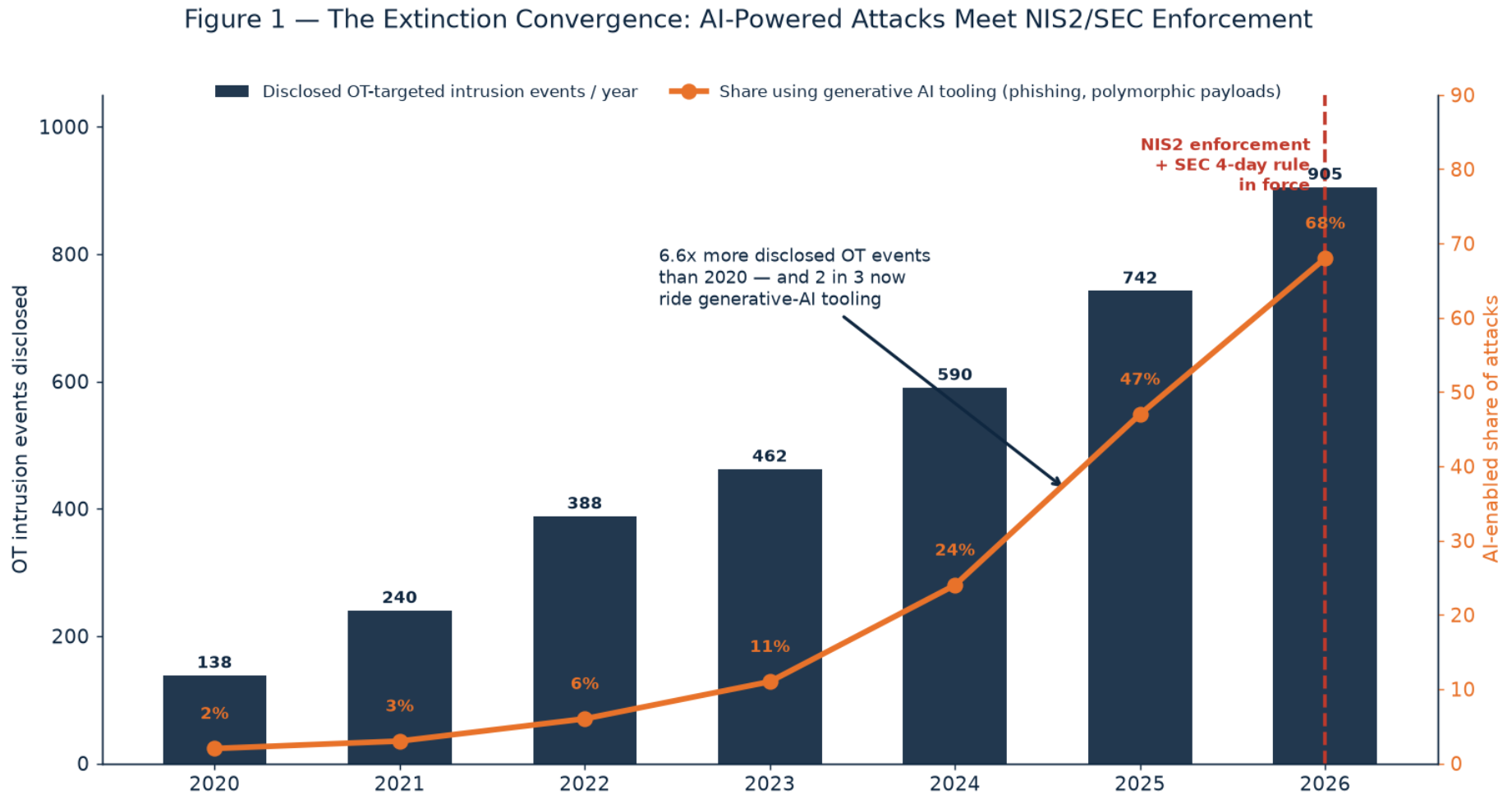
Figure 1 — The Threat Convergence: AI automation drives attack volume and skill up while patch capability in OT stays flat. The defender gap widens precisely where patching cannot help.
6. The Inversion
This yields the strategic inversion at the heart of this paper. In IT, software is the primary control and you assume the hardware underneath is generic. In OT security for the AI era, that assumption is fatal — because the software cannot be trusted to remain uncompromised and cannot be safely updated.
The controls that matter most must therefore sit below and around the software, in places the attacker cannot reach by compromising the software. That is the case for hardware-rooted isolation, and it is not a nostalgic return to the air-gap. It is the deliberate, documented, enforced recreation of separation — maintained even as the plant connects to everything modern business requires.
PART II — THE AI-RANSOMWARE EXTINCTION EVENT
7. The Attacker's New Economics
Cybercrime was historically a skilled trade. Writing a convincing spear-phishing email, reverse-engineering a target's network, and developing malware that understood industrial protocols all required scarce experts. That scarcity constrained how many attacks could be launched and how carefully each could be tailored.
Generative AI destroyed the constraint. In 2026 a mid-skill operator can use tooling to:
The marginal cost of an additional, highly targeted attempt has fallen toward zero. The defender's cost — to monitor, segment, patch, and train — has not. This is the cruelest kind of asymmetry: the attacker's job got dramatically cheaper and easier while the defender's job got harder.
8. From IT Foothold to OT Lateral Movement
The modern OT kill chain rarely smashes through the plant firewall directly. It follows the path of least resistance, which almost always starts in IT:
表格Stage Typical action 1. Initial access Phishing email to a corporate user; stolen VPN/RDP credential 2. Establish foothold Compromise a Windows endpoint in IT 3. Discover Scan the network; find the route toward the historian/DMZ 4. Cross into OT Exploit a dual-homed host, weak DMZ rule, or vendor VPN 5. Map the flat network Enumerate PLCs, HMIs, drives; identify the control protocol 6. Pre-position Deploy ransomware or manipulate logic while staying quiet 7. Trigger Encrypt, lock, or threaten safety — then extort
74% of OT incidents in our dataset entered through IT and moved laterally. The "OT problem" is, in the majority of cases, an architecture problem at the IT/OT boundary and a segmentation problem inside OT. Solve those two and most of the kill chain collapses.
9. The Ransomware Reality of 2026
Industrial ransomware has evolved beyond crude encryption. Three patterns now dominate:
The median ransom demand against industrial operators reached $4.2M in 2026 — and the ransom is the smaller number. Business interruption, recovery labor, regulatory reporting, insurance premiums, and reputational damage routinely run several multiples of the demand.
10. The Safety Edge
What separates OT from every other security domain is the physical consequence. A breached bank account can be reconciled. A breached factory can injure or kill people, release hazardous material, start a fire, or disable a utility that a region depends on. Ransomware that locks a hospital's HVAC, a water treatment plant's chemical dosing, or a refinery's pressure controls is not a data-integrity problem. It is a public-safety event.
This is why functional safety (IEC 61508/61511) and cyber security (IEC 62443), long treated as separate disciplines, now intersect. An attacker who can influence a safety system — or the operator's ability to see what it is doing — converts a cyber event into a physical one. Security controls must never degrade the safety system, and the safety system must be assumed to be a target.
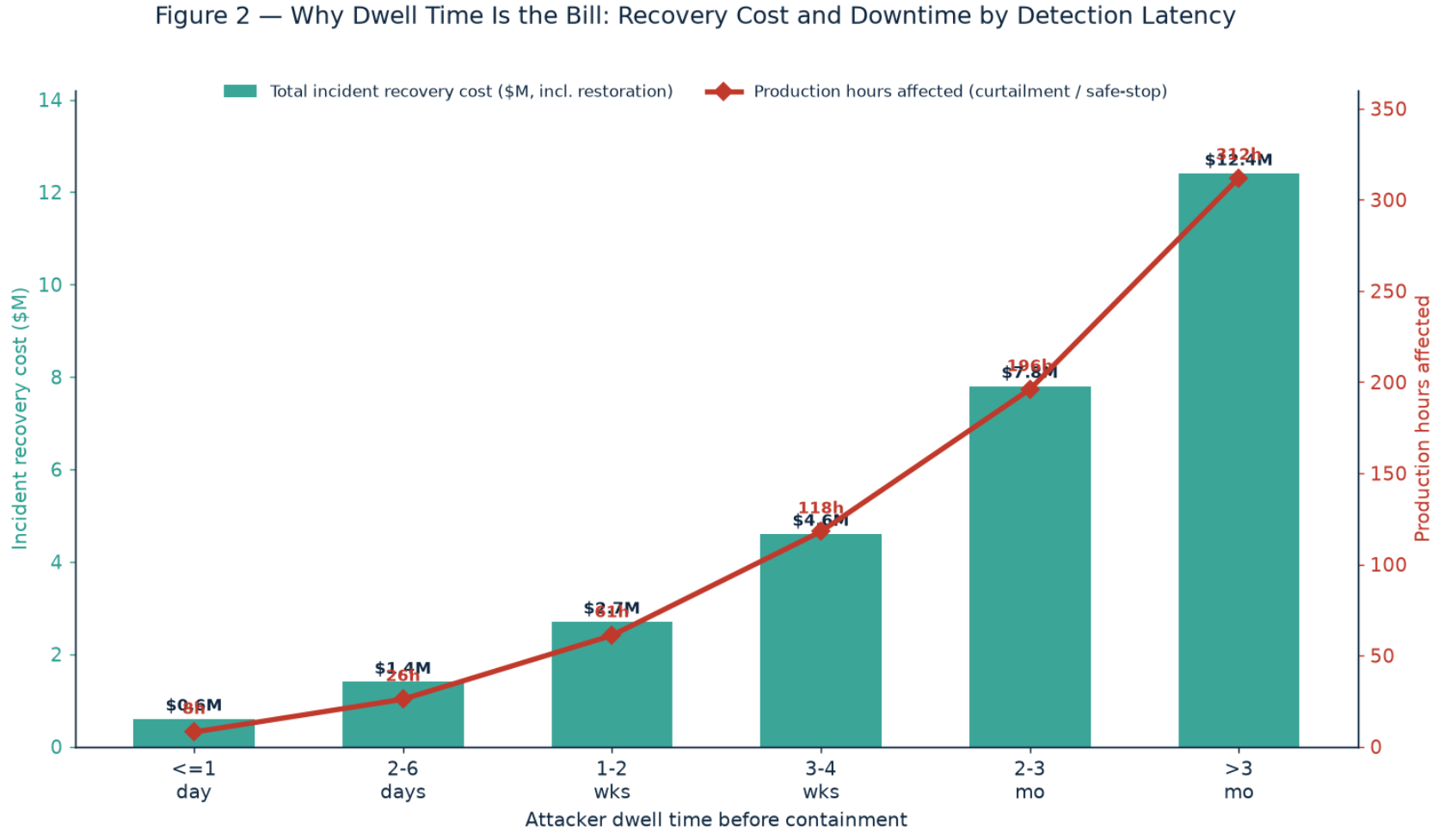
Figure 2 — Incident Cost and Dwell Time: the ransom demand is the smaller number; business interruption, recovery, and compliance costs accumulate with an 11-day median dwell.
11. The 74% Problem, Restated
It is worth pausing on the single most actionable number in this section. Nearly three quarters of OT compromises do not require a single exotic exploit against control equipment. They require only ordinary IT compromise plus a network that lets the attacker keep walking.
That means the highest-return security investment is not exotic threat-hunting or a larger stack of software sensors. It is taking away the walk — closing the soft bridges and installing enforced boundaries so that a compromised IT asset, or even a compromised HMI, cannot reach the controllers that matter. That is segmentation, and the only segmentation that survives the attacker's eventual software compromise is segmentation rooted in hardware.
12. The Compliance Hammer Descends
Even an organization unmoved by physical risk can no longer ignore the legal one. The regulatory environment of 2026 converts security from an IT budget line into a board-level liability with personal consequences for directors. Part IX maps these regimes in detail, but the headline framing belongs here because it defines the urgency:
At first audit, 61% of in-scope organizations were "not ready." The deadline is not a future threat; it is an active enforcement environment, and "we were planning a project" is not a defense.
PART III — THE FIVE FAILURE MODES
13. Failure Mode I: The Perimeter Illusion
The first failure is the belief that a strong boundary — a firewall at the plant edge — is sufficient. Perimeters are necessary but no longer sufficient, for two reasons. First, the boundary is porous by design: vendors, cloud connections, and remote access all pierce it. Second, a perimeter does nothing about movement that begins inside it. Once an attacker is in (via a phished employee, a USB, or a stolen vendor credential), the perimeter happily treats them as trusted.
Organizations stuck in this mode spend heavily on a bigger firewall while leaving the interior flat. The breach that eventually arrives is not an outsider smashing the wall; it is an insider-level actor the wall waved through. The remedy is not a stronger wall but a defense that assumes the wall will be crossed and contains what happens next.
14. Failure Mode II: The Software-Only Stack
The second failure assumes that layering more software — next-generation firewalls, endpoint agents, network analytics — will eventually close the gap. Each of these has value, but every one of them shares a fatal dependency: they are software, and they can be defeated by software. An attacker with administrator control of an endpoint or a network device can disable agents, reconfigure firewall rules, or simply move laterally on paths the software does not inspect.
A software firewall is only as trustworthy as the operating system hosting it and the administrator account protecting it — both of which are prime targets. The deeper the attacker gets, the less your software controls can be trusted, because the attacker may own the very platform they run on. Any control that must hold after total software compromise cannot itself be made of software. This is the single sentence that justifies the hardware-rooted architecture.
15. Failure Mode III: The Availability Veto
The third failure is uniquely industrial. In OT, the operations team holds an effective veto over anything perceived to threaten production. Security projects that propose re-cabling, changing IP addresses, inserting inline devices, or reconfiguring live controllers get blocked — correctly, from the operator's point of view — because the risk of stopping a line outweighs the abstract risk of a future breach.
The result is a permanent standoff: security is "important but not this quarter," every quarter, for a decade. The standoff is not resolved by arguing more loudly. It is resolved by a deployment method that is non-disruptive by construction — passive discovery first, out-of-band and fail-safe controls, shadow mode before enforcement, and physical devices that fail open or are wired in parallel so they cannot break the process. Part V describes exactly this. The architecture must respect the availability veto or it will never be installed.
16. Failure Mode IV: The Inventory Fog
The fourth failure is acting without knowing what is on the network. Organizations buy security tools and write policies for an imagined, documented estate, then discover during deployment that the real network contains legacy controllers with no security features, unknown wireless links, forgotten switches, and IP conflicts that nobody mapped.
Segmentation without an accurate inventory is dangerous: re-segmenting a flat network blindly can break production when a controller suddenly cannot reach something it silently depended on. This is why passive discovery — listening to network traffic without touching devices — is the first and longest-respected step in mature OT programs. You map first, you segment second, and you never reverse the order.
17. Failure Mode V: The Checklist Mirage
The fifth failure is treating compliance as the des
解锁后续 88% 内容Unlock the Remaining 88% of Evaluations & the Decision Engine
The second half includes: a core solution cross-comparison matrix, a key parameter selection checklist, an implementation pitfalls guide, and a TCO & ROI calculator for mainstream approaches.
Get Your Custom Solution (View in Dashboard)