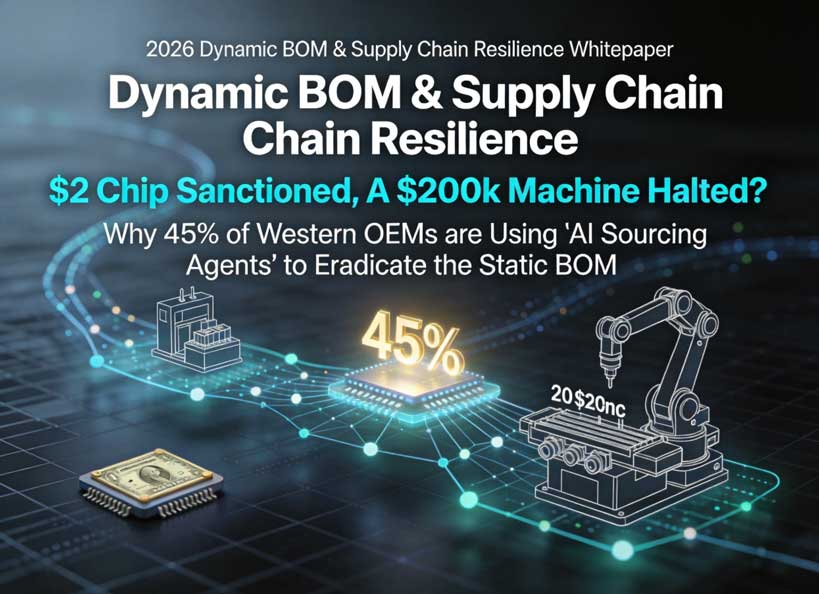
2026 Dynamic BOM & Supply Chain Resilience Whitepaper: AI Sourcing Agents End Static BOM
2026-10-04 19:11:00
#CEO#Chief Procurement Officer#CTO#VP of Hardware Engineering#Supply Chain SVP
Executive Summary
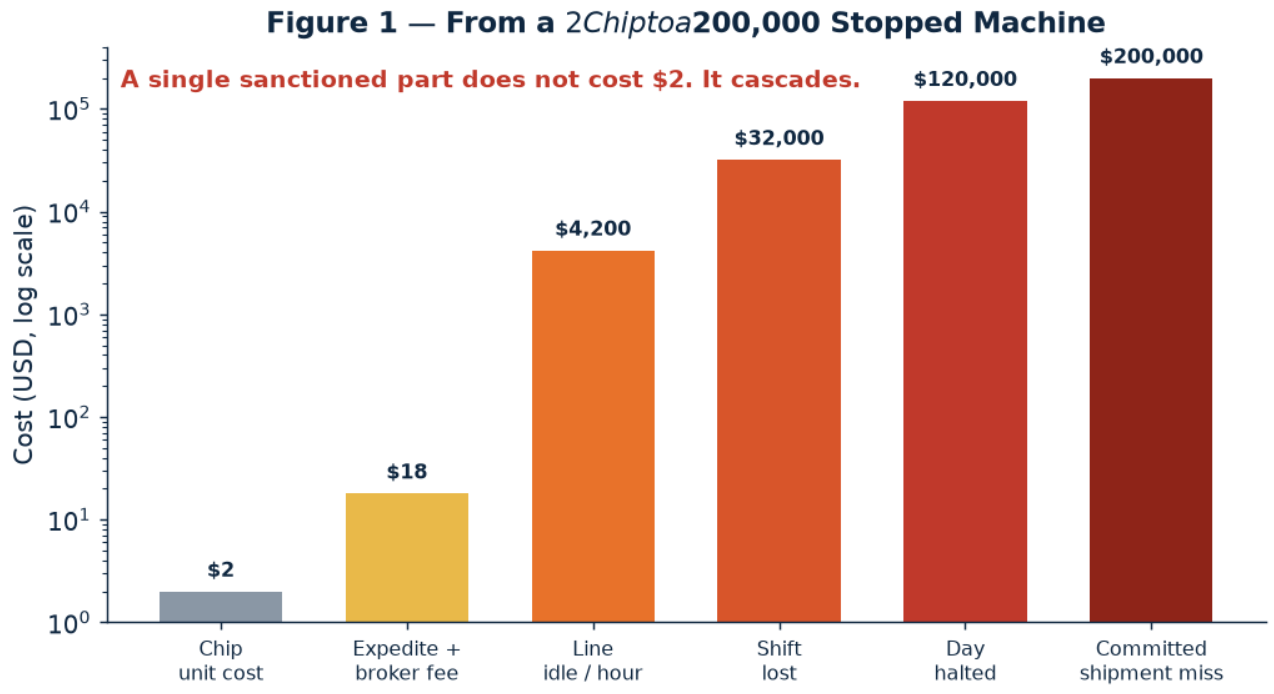
Here is the short version. A modern industrial product contains hundreds to tens of thousands of electronic and mechanical line items, and for most of its life its bill of materials is treated as a fixed, frozen document. That assumption was already expensive; in 2026 it is dangerous. Sanctions regimes expand on political timelines no procurement calendar anticipates, components go end-of-life on vendor roadmaps, and a single unavailable two-dollar part can idle a two-hundred-thousand-dollar machine and miss a committed shipment. The cost is not the price of the part. It is the cascade.
The organizations pulling ahead have stopped reacting to each shock with panic redesigns and broker purchases at five to twenty times list price. They are treating the BOM as a living system: continuously monitored supplier and part intelligence, a hardware-abstraction layer that makes substitution a design property rather than an emergency, and AI sourcing agents that find, risk-score, and qualify alternates — acting autonomously only inside a validated envelope and deferring to engineering outside it. This paper describes why the static BOM fails, what the dynamic-BOM stack looks like, how to build and deploy it in five steps, and what it costs and returns.
What the field data shows (360+ advanced-manufacturing & R&D sites, North America & Europe, 2025–2026):
表格Finding Reference figure OEMs deploying or piloting AI sourcing agents 45% BOM lines single-sourced / single-country for critical ICs 64–68% Lines that have halted production on one unavailable part (last 24 mo) 61% Premium paid through brokers in a shortage 5–20x list Engineering time consumed by reactive part substitution ~30% of hardware-team capacity Typical first-line program cost $470,000 Year-one value (avoided loss + savings) ~$620,000 Payback ~9 months Broker/expedite spend after deployment −62%
Three conclusions follow and they structure the rest of the paper. First, resilience is a design property, not a stockroom tactic — over-buying safety stock and panic-buying from brokers are both symptoms of a frozen BOM. Second, hardware abstraction is the unlock: when firmware and board design are written against portable interfaces and footprint families, swapping a sanctioned part becomes a qualification exercise rather than a redesign. Third, the AI agent's autonomy must be bounded exactly as control autonomy is bounded — validated alternates, live compliance and risk scores, and a hard gate that refuses action when confidence or coverage is insufficient.
How to read this paper. Parts I–IV establish the problem: the cost cascade, the exposure hidden in a typical BOM, the death spiral of reactive freezing, and the five-layer dynamic-BOM stack. Parts V–VIII cover execution: the five-step method, the economics, a guarded-substitution walkthrough, and field cases. Parts IX–XI cover governance, organization, and the 90-day start. Parts XII–XIII are an engineering deep dive and a leader's handbook. The appendices provide the SKU catalog, the abstraction-pattern library, the qualification checklist, the ROI model, a glossary, and RFP language.
PART I — THE TWO-DOLLAR PART THAT STOPPED THE FACTORY
1. A Quiet Tuesday
The scenario is unremarkable because it is now common. A procurement analyst screens a newly updated control list and flags a commodity logic device — unit cost under two dollars — used across several controller boards. The part is not exotic; it is simply manufactured in a jurisdiction that a new measure now restricts. Within days the authorized channel stops quoting, the few distributors with stock withdraw it from open sale, and the production planner discovers the line carries roughly three weeks of that part against a twelve-week qualification cycle for anything else.
2. What "Unavailable" Actually Means
The part is not physically scarce in the world; it is administratively unavailable to this buyer. That distinction matters because traditional supply-chain responses were built for physical scarcity — allocate supply, find more vendors. An administrative barrier cannot be solved by paying more to the same source, and it does not arrive with the lead time of a capacity shortage. It arrives on the effective date of a rule, often with a short notice window, and it changes the legal status of a purchase that had been routine for years.
3. The Cascade Is the Cost
The two-dollar figure is the smallest number in the story. Once the part is unavailable, a sequence of costs begins: expedited sourcing and broker premiums, engineering pulled onto an unplanned redesign, qualification consuming test capacity, the line running down its buffer and then idling, and — if the timing is wrong — a committed shipment missed with contractual and relationship consequences. The part's price is the trigger; the machine, the labor, and the commit are the cost. Figure 1 traces that amplification.
4. Why the Magnitude Feels Disproportionate
A single missing low-level component can stop a high-value product because modern manufacturing is tightly sequenced and the BOM is treated as conjunctive: every line must be available for the product to ship. There is no partial completion for a missing controller IC the way there might be for a delayed cosmetic item. High-value equipment — the die-cast cell, the SMT line, the test stand — is also where fixed cost concentrates, so an idle hour is expensive even before considering penalties. The ratio between a two-dollar part and a two-hundred-thousand-dollar stoppage is not an anomaly; it is the structure of conjunctive, capital-intensive production.
5. It Is Not Only Sanctions
The same cascade is triggered by ordinary vendor decisions: an end-of-life notice for a mature part, a package change, a fab allocation that favors larger customers, or a supplier exiting a low-margin product family. Geopolitical measures are the most dramatic driver, but the underlying condition is that a frozen BOM depends on decisions the OEM does not control, made on timelines it does not set. Solving only for sanctions would leave the more frequent EOL and allocation shocks untouched.
6. The Reflex That Fails
The first reflex is to protect the frozen BOM: buy more buffer stock, chase brokers, and when the shock hits, freeze the design even harder to avoid further change. Each of these actions treats resilience as inventory and stability as rigidity, and each makes the next event more expensive. The strategic shift this paper describes is different — make the BOM itself capable of controlled change, so that the loss of any single source is an event the system is designed to absorb rather than a crisis it survives reactively.
PART II — THE EXPOSURE HIDDEN IN YOUR BOM
7. What a BOM Actually Contains
A bill of materials is usually understood as a list of parts and quantities, but operationally it is a web of dependencies: each line ties the product to a specific manufacturer, a specific fabrication site and country, a specific package and footprint, and a specific set of firmware assumptions. Exposure is not visible from the part number; it is visible only when those dependencies are examined. Two boards with superficially similar part lists can have radically different resilience depending on how many lines are dual-sourced and abstracted.
8. Single-Source Concentration
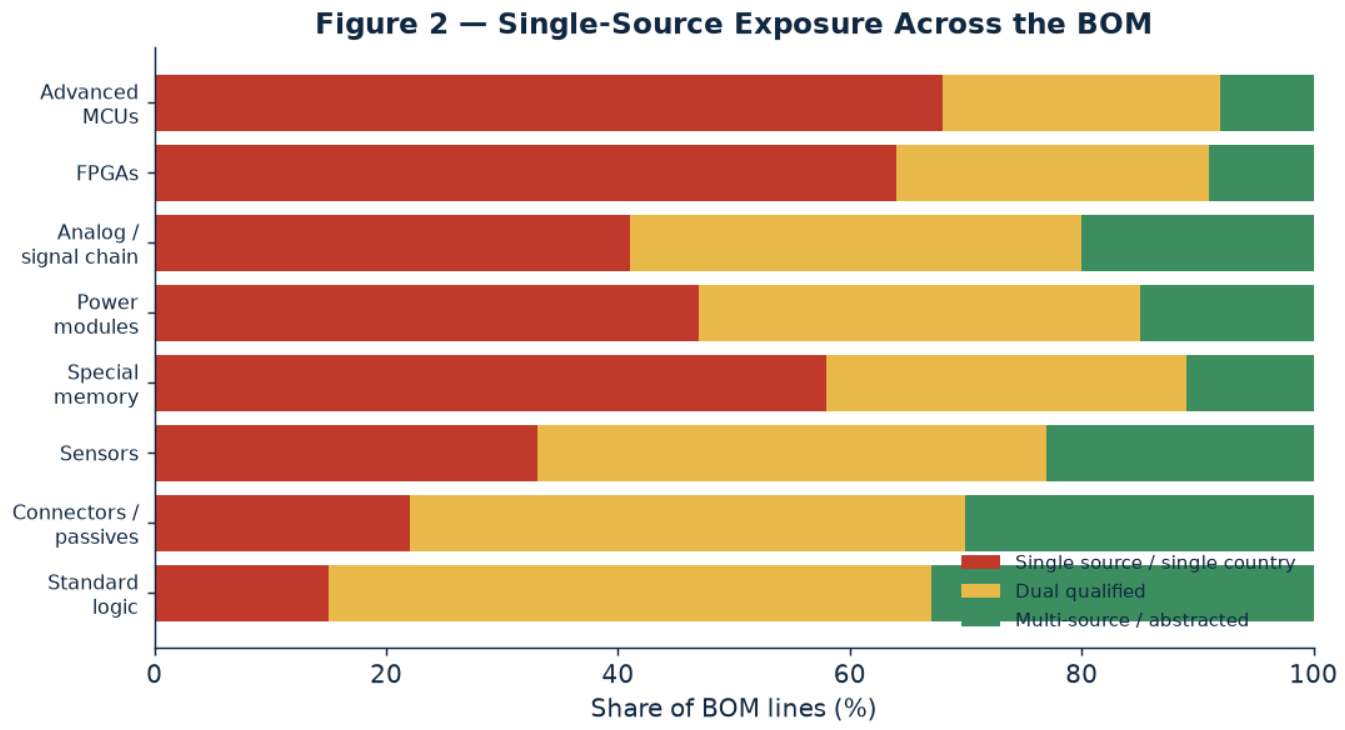
Across the field sample, the most critical integrated-circuit categories are also the most concentrated. Advanced microcontrollers and FPGAs — the devices most difficult to substitute because firmware is written to their specifics — show the highest single-source and single-country exposure, while commodity passives and standard logic are far more diversely sourced. The risk is concentrated precisely where substitution is hardest, which is why a generic "second-source everything" directive is both expensive and insufficient. Figure 2 shows the pattern by category.
9. The Geographic Layer Beneath the Vendor Layer
Dual-sourcing from two vendors that both fabricate in the same jurisdiction is not true dual-sourcing against an administrative shock; it is two purchase orders with one underlying geographic dependency. Mature resilience analysis distinguishes vendor diversity from fab-site and country diversity, because the binding constraint in a sanctions or export-control event is geography more than brand. Many organizations that believed they were dual-sourced discovered, under an actual restriction, that both options depended on the same region.
10. Qualification Debt
Even where a technical alternate exists, it is not usable until it is qualified. Most organizations qualify the primary part thoroughly and treat alternates as paperwork to be completed "if we ever need it" — which means the qualification is not done, test capacity is not reserved, and when the need arrives the alternate is theoretical. This qualification debt is an invisible lead time: the organization may hold a list of candidates, but none are actually cleared to ship. Resilience requires alternates to be pre-qualified, not merely identified.
11. Firmware Coupling
The deepest and least visible dependency is software. When firmware is written directly against a specific device's registers, peripherals, and timing, changing the silicon means rewriting and revalidating the firmware — often the longest item on the critical path. This is the reason MCUs and FPGAs are so hard to substitute even when a functionally similar part exists: the substitution is not electrical but software. Organizations that address sourcing without addressing this coupling can qualify a new part and still be unable to use it for months.
12. The Concentration Paradox
There is a cruel pattern in the data: the categories where a stoppage would be most damaging (high value, hard to redesign, custom firmware) are the categories most likely to be single-sourced, while the easy-to-substitute commodity parts are already diversely sourced. Risk and difficulty are correlated rather than offset. This is precisely why the problem cannot be left to procurement alone — resolving the concentrated, firmware-coupled, geographically dependent lines is an engineering and architecture decision, not a purchasing decision.
13. Measuring Exposure Honestly
The first honest metric is not "number of suppliers on file" but the share of critical BOM lines that have a pre-qualified alternate from a different fab geography, behind an abstracted interface. Few organizations can state this number on day one, because the data to compute it — lifecycle status, fab geography, qualification status, firmware coupling — lives across procurement, engineering, and quality systems and is rarely unified. Establishing that single, defensible exposure metric is the first output of the method in Part V.
PART III — THE DEATH SPIRAL OF THE FROZEN BOM
14. The Intuition That Traps You
"Don't change a shipping design" is sensible engineering advice for a stable world: change introduces risk, revalidation costs money, and a proven configuration is valuable. The intuition fails when the world outside the design changes faster than the design can stay still. A policy of maximum rigidity, intended to minimize risk, ends up maximizing the organization's exposure to shocks it cannot prevent — because the only thing it controls is its own ability to respond, and that is exactly what it suppresses.
15. The Spiral, Step by Step
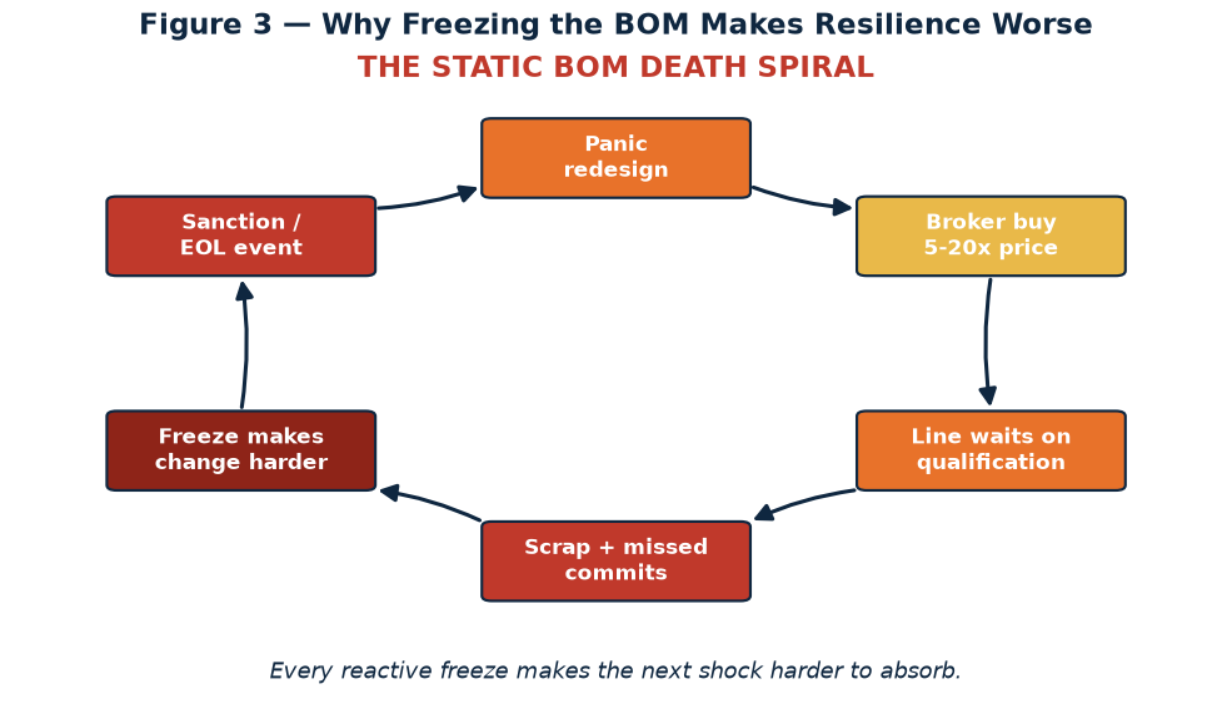
When a part is sanctioned or goes end-of-life, the sequence is predictable: an emergency redesign is opened, brokers are paid a large premium to bridge the gap, the line waits on qualification, scrap and missed commitments follow, and the post-crisis reaction is to freeze the BOM even harder to prevent future disruption. Each freeze reduces the organization's ability to make the controlled, pre-planned changes that would reduce exposure, ensuring the next shock is again an emergency. Figure 3 depicts the loop.
16. Why Inventory Is Not the Answer
Safety stock is the most common compensating tactic and it has a place, but it is not resilience. Holding inventory requires forecasting which part will be affected — and the next shock is, by definition, the one you did not forecast, so you over-hold many parts and under-hold the one that matters. Inventory also ties up capital, ages into obsolescence, and only delays rather than resolves the underlying dependency. Buffer stock converts a sudden stoppage into a slower stoppage; it does not remove the single point of failure.
17. The Broker Tax
In a shortage, the marginal source of supply is the broker, and the price reflects urgency rather than value — premiums of five to twenty times list are routine for constrained parts. Brokers also introduce quality and provenance risk: the chain of custody is longer, counterfeit and refurbished material enters the market precisely when buyers are least able to be selective, and a broker-bridged line may solve availability while creating a quality escape. Treating broker spend as a normal procurement category normalizes a cost that a dynamic BOM is designed to eliminate.
18. Engineering Capacity as the Hidden Casualty
Reactive substitution is expensive partly because it consumes the scarcest resource: experienced hardware and firmware engineers. Each emergency redesign pulls engineers off new-product work and onto unplanned maintenance of an old design, and the work is urgent rather than important — the kind that cannot be deferred and cannot be planned. Teams in the field report roughly thirty percent of hardware-engineering capacity absorbed by reactive part issues, which is capacity that is, in effect, being paid to compensate for a BOM that was never designed to change.
19. The Freeze Makes Qualification Harder
The harder the BOM is frozen, the less the organization practices qualifying alternates, so when one is required the process is slow, unfamiliar, and uncompetitive for test capacity. Organizations that continuously qualify a portfolio of alternates keep the muscle exercised, the paperwork current, and the test slots reserved; frozen-BOM organizations must rebuild the capability under deadline. Resilience here is perishable — an alternate qualified once and then left unmaintained becomes stale as specifications and standards drift.
20. Breaking the Loop
The loop breaks at the post-crisis reaction: instead of freezing harder, use the event to build the structural capability that would have made it non-emergency — unified part intelligence, abstraction that decouples firmware from silicon, and a continuously qualified alternate pool. The same event that triggers a crisis in a static-BOM organization becomes, in a dynamic-BOM organization, a routine substitution within an envelope that was prepared in advance. The rest of this paper is about building that structure.
PART IV — THE DYNAMIC BOM STACK
21. From Document to System
The conceptual shift is to stop treating the BOM as a document that is occasionally edited and start treating it as a living system with layers, each serving a distinct purpose. The bottom layers hold clean, continuously updated facts about parts and suppliers; the middle layers make substitution structurally possible; and the top layer — the AI sourcing agent — acts within a validated envelope. Figure 4 shows the five layers.
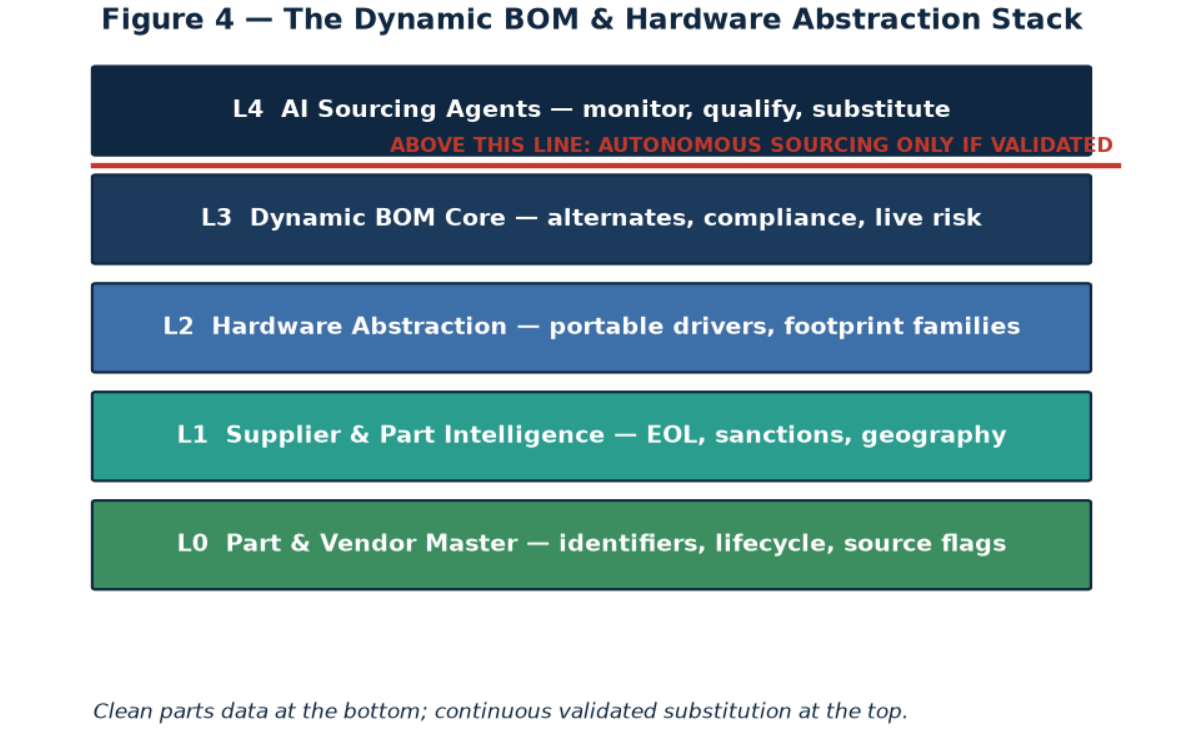
22. L0 — The Part and Vendor Master
Everything rests on a clean master: unambiguous part identifiers, lifecycle status, manufacturer and vendor records, source and geography flags, and links from each BOM line to the underlying part record. In most organizations this data is fragmented across ERP, PLM, spreadsheets, and supplier portals and is riddled with duplicates and stale entries. L0 is unglamorous and indispensable — no amount of agent intelligence can compensate for part data that does not correctly say what a thing is or where it comes from.
23. L1 — Supplier and Part Intelligence
Above the master sits continuously updated intelligence: end-of-life and change notices, sanctions and export-control status, fab-site and sub-tier geography, financial-health indicators, and observed lead-time and quality performance. This is the layer that turns a static record into a monitored one — it knows that a part is on a watch list before the effective date, that a supplier is exiting a family, or that a nominally dual-sourced part depends on one region. The intelligence graph is what gives an agent something trustworthy to reason over.
24. L2 — The Hardware Abstraction Layer
This is the structural unlock. Hardware abstraction means designing firmware and boards against portable interfaces rather than specific devices: driver layers that isolate register specifics, standardized pin and footprint families, and boards laid out so an approved alternate drops into the same footprint or a documented variant. With abstraction in place, substituting a part changes a contained driver and a qualified footprint rather than the whole firmware and board design. Without it, even a perfect intelligence layer can only warn of a redesign you still must do.
25. What Abstraction Costs
Abstraction is not free — it adds a layer of firmware, some upfront design discipline, and occasionally a small efficiency cost versus writing directly to one device. But the cost is paid once, in planned engineering, against a cost that is otherwise paid repeatedly, in emergency engineering, for every affected part over the product's life. The economic question is not "is abstraction overhead" but "is the overhead smaller than the repeated crisis cost it prevents," and for long-lived industrial products with many BOM lines, the answer is decisively yes.
26. L3 — The Dynamic BOM Core
The core brings it together: for each line, the set of approved alternates with their qualification status, live compliance and risk scores derived from L1, and the rules governing which substitution is permitted under what conditions. This is the controlled source of truth an agent acts against — it separates alternates that are merely technically similar from those that are qualified, compliant, and in-scope, and it records the envelope within which automatic substitution is permitted.
27. L4 — The AI Sourcing Agent
At the top, the agent works continuously rather than at quarterly reviews: it monitors intelligence, detects exposure before a shock, proposes and risk-scores alternates, initiates and tracks qualification, and — inside the validated envelope — executes substitution and reorders. Outside that envelope it does not act autonomously; it prepares the analysis and escalates to engineering and procurement. The agent's value is continuous attention at a scale no human team can maintain, bounded by the same discipline that governs any autonomous system.
28. The Red Line
The stack has a deliberate line between the top agent and the layers beneath: above it, autonomous sourcing is permitted only where the alternate is validated, the compliance and risk score clears its threshold, and the action is inside the documented envelope. Below the line, the system recommends and prepares. This is not a technical limit that can be assumed away; it is the governance boundary that keeps continuous automation safe, and it is enforced in software rather than relied upon as policy.
29. Why This and Not a Chatbot
A general-purpose conversational tool can answer questions about parts but cannot safely execute substitution, because it does not own the controlled relationships among qualification status, compliance, geography, and abstraction that determine whether an action is safe. The dynamic-BOM stack is purpose-built: deterministic rules at the core, intelligence continuously verified, and learned behavior confined to discovery and ranking within a validated structure. Resilience is an engineered capability, not a question-answering feature.
PART V — THE FIVE-STEP BUILD-AND-DEPLOY METHOD
30. Why a Defined Sequence Matters
As with other industrial-AI deployments, the risk is not the technology failing to work in isola
解锁后续 88% 内容Unlock the Remaining 88% of Evaluations & the Decision Engine
The second half includes: a core solution cross-comparison matrix, a key parameter selection checklist, an implementation pitfalls guide, and a TCO & ROI calculator for mainstream approaches.
Get Your Custom Solution (View in Dashboard)