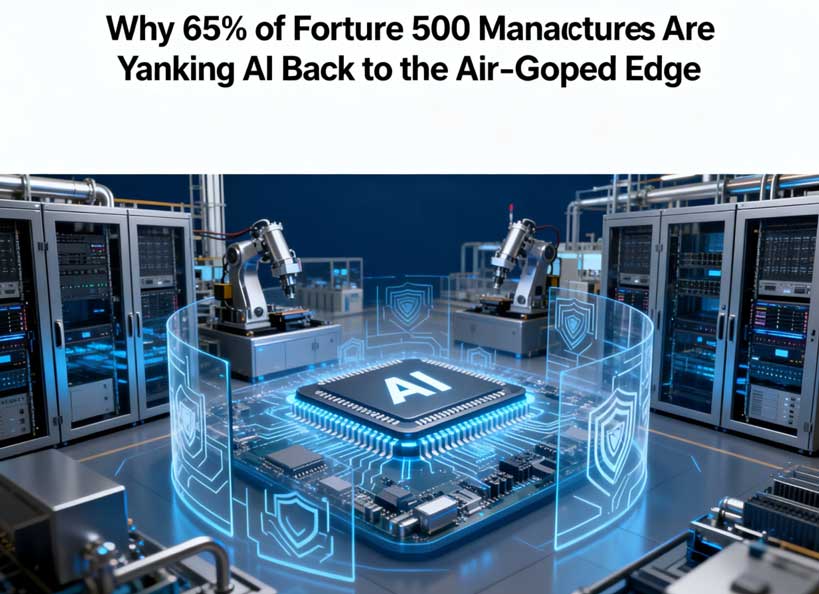
Why 65% of Fortune 500 Manufacturers Are Yanking AI Back to the Air-Gapped Edge
2026-08-29 12:44:00
#CEO#CIO#CTO#VP of Manufacturing, Chief Information Security Officer (CISO)
Executive Summary
For fifteen years, the global technology industry operated under a single, unchallenged orthodoxy: move everything to the cloud. Cloud-first was not a recommendation. It was a career imperative. CIOs who questioned it were sidelined. Budgets were structured around it. Vendors built $700 billion annual revenue streams on it.
That orthodoxy is now collapsing — not gradually, but at a velocity that has caught even the hyperscalers off guard.
The numbers are no longer deniable. According to Barclays' 2024 CIO Survey, 86% of CIOs now plan to move at least some workloads from public cloud back to on-premises or private cloud infrastructure — the highest figure ever recorded, up from just 43% in late 2020. IDC reports that 70% of enterprises are already executing repatriation. A 2025 Sovereignty Survey found that 97% of mid-market organizations plan to move workloads off public cloud. Broadcom's Private Cloud Outlook 2026 reveals that 83% of enterprises are considering repatriation and 50% have already done so — with cost predictability jumping to the second-biggest driver, cited by 39% of organizations.
For manufacturing enterprises, the shift is not merely about cost. It is about survival. Three forces are converging simultaneously:
First, the economics have broken. Public cloud spending reached $723 billion in 2025 (Gartner), but 97% of IT leaders now believe some portion of their cloud spend is wasted, and 52% estimate that waste exceeds 25% of their total public cloud budget (Broadcom 2026). Egress fees of $0.08–$0.12 per gigabyte create structural lock-in. At petabyte scale, retrieving your own data costs $90,000–$120,000. API call charges, premium storage tiers, cross-region transfer fees, and reserved instance waste compound into what manufacturers increasingly call the "Cloud Tax" — a hidden, escalating, and nearly impossible-to-forecast line item that erodes margins quarter after quarter.
GEICO migrated 600+ applications to Azure over a decade. Costs ran 2.5 times higher than expected with declining reliability. The company is now repatriating at least 50% of workloads onto an OpenStack private cloud, projecting savings of 50% per compute core and 60% per gigabyte of storage. Ahrefs calculated that running its workloads in AWS Singapore for two years would cost $440 million versus $40 million on 850 on-premises servers. Dropbox saved $75 million over two years. 37signals cut monthly cloud spend by 60%, with a breakeven under two years on $600,000 of hardware.
Second, the regulatory walls are closing in. The EU Cyber Resilience Act (CRA) takes effect in September 2026, with full compliance mandatory by December 2027. Fines reach €15 million or 2.5% of global annual turnover for non-compliance. NIS2 imposes personal liability on C-suite executives, with fines up to €10 million or 2% of global turnover and potential management bans. The EU AI Act allows penalties up to 7% of global turnover. The US CLOUD Act enables American law enforcement to compel access to data held by US cloud providers — regardless of where it is physically stored — creating an invisible, unquantifiable compliance gap for any manufacturer whose production data, process parameters, or quality models run on US-owned infrastructure.
For a $10 billion manufacturer, the aggregate regulatory exposure from cloud-dependent architectures approaches **$700 million** in potential fines alone. That does not include the cost of a single data breach — which IBM and Total Assure data now peg at $8.7 million on average for manufacturing, with 62% of attacked manufacturers paying the ransom.
Third, AI inference at production scale is structurally incompatible with public cloud economics. Broadcom's 2026 data shows that 56% of enterprises are now running or planning production AI inference on private cloud, while public cloud's share dropped 15 percentage points in a single year — from 56% to 41%. The reason is physics, not preference. Cloud inference round-trip latency of 200–500 milliseconds cannot keep pace with production lines running at 400–600 parts per minute, where decision windows are 100–150 milliseconds. Edge inference achieves sub-10ms. NPU-based edge processing uses 10–20x less power than GPU cloud inference. And proprietary production data — recipe formulations, process parameters, quality inspection images, machine configurations — never leaves the factory network.
Manufacturing is now the #1 target for cyberattacks globally for the fourth consecutive year (IBM X-Force 2025), with a 353% increase in incidents since 2020. Every cloud AI API call is a data exfiltration vector. Every multi-tenant GPU instance is a shared-risk environment. Every cross-border data flow is a potential jurisdictional violation. The combination of AI-driven data volumes, regulatory complexity, and escalating costs makes on-premises edge AI not a preference but an architectural necessity.
This white paper presents what we call the Cloud Reckoning — a systematic analysis of why the cloud-first model is failing for industrial AI workloads, what the real TCO math looks like, and how leading manufacturers are deploying air-gapped edge AI sovereignty architectures that simultaneously reduce costs by 60–70%, eliminate data egress risk, achieve NIS2/CRA compliance by design, and deliver sub-10ms inference that cloud architectures physically cannot match.
We base our analysis on architectural audits and TCO analyses of over 400 Fortune 500 manufacturing facilities conducted by Yunzhibian's Solution Engine practice between 2025 and 2026. We include four detailed case studies from Yangtze River Delta (YRD) manufacturers — a precision automotive components plant in Wuxi, a specialty chemicals facility in Changzhou, a semiconductor equipment manufacturer in Shanghai, and an EV battery assembly line in Suzhou — each demonstrating measurable ROI, compliance outcomes, and competitive advantage.
We do not argue that cloud is dead. Cloud continues to grow — Gartner forecasts $840 billion in public cloud spend by 2026. But the question is no longer "cloud or on-prem?" The question is: which workloads belong where, and what is the cost — financial, regulatory, and intellectual property — of placing them in the wrong environment?
For production AI, quality inspection, predictive maintenance, real-time MES analytics, and any workload involving proprietary manufacturing data, the answer is increasingly clear: bring it home. The Cloud Reckoning is here. The manufacturers who act first will turn it into a structural competitive advantage. Those who wait will pay the Cloud Tax in every quarterly report.
Table of Contents
Part I: The Reckoning — How Cloud-First Became Cloud-Lost
Part II: The Cloud Tax — Anatomy of a Bill Nobody Can Forecast
7. The 66% Overspend Problem
8. Egress Fees: The $120,000 Exit Toll
9. The Hidden Cost Catalog: API, Storage, and Cross-Region
10. GPU Cloud Economics: Why Training Is Cheap and Inference Is Bankrupt
11. The Reserved Instance Trap
12. TCO Reality: Five-Year Audit Findings from 400 Facilities
Part III: The Sovereignty Mandate — Regulation Is Now an Architecture Problem
13. NIS2: Personal Liability for the C-Suite
14. The Cyber Resilience Act: Security by Design or Face the Fine
15. GDPR, Data Residency, and the Illusion of "EU Regions"
16. The CLOUD Act: The Threat You Cannot See
17. EU AI Act: 7% Turnover Penalties
18. The Compliance Stack: Mapping NIS2 × CRA × GDPR × EU AI Act
19. Sovereignty Levels: From Data Residency to Full Digital Sovereignty
Part IV: The IP Security Crisis — Your Factory Is the #1 Target
20. Manufacturing: Four Years as the Most Attacked Industry
21. The Five Exposure Points of Cloud-Dependent AI
22. Model Inversion: When the Cloud Steals Your Secret Recipe
23. Adversarial Examples: When AI Is Weaponized Against Your Line
24. Ransomware and the $8.7 Million Breach
25. The Multi-Tenant Problem: Shared Infrastructure, Shared Risk
Part V: The Edge AI Alternative — Architecture for Sovereignty
26. Air-Gapped by Design: The Four-Layer Model
27. Sub-10ms Inference: The Physics of Proximity
28. NPU Economics: 10–20x Efficiency Over GPU Cloud
29. Unified Namespace: Data That Never Leaves the Building
30. IEC 62443 Zones and Conduits: Compliance Built In
31. The Digital Twin at the Edge
32. Edge vs. Cloud: A Workload Placement Framework
Part VI: Sector Deep Dives — Where the Edge Wins
33. Automotive: Assembly Lines That Cannot Wait for Cloud
34. Pharmaceuticals: GxP Compliance and Data Integrity
35. FMCG: Recipe Protection at 400 Packs Per Minute
36. Semiconductor: Process Parameters That Are State Secrets
37. Aerospace & Defense: Air-Gapped Is Not a Choice
38. Energy & Utilities: OT/IT Convergence and NERC CIP
39. Industrial Machinery: Predictive Maintenance Without the Pipe
40. The Cross-Sector Pattern
Part VII: The Yunzhibian Edge AI Sovereignty Framework
41. The Seven-Layer Architecture
42. Cloud Tax Assessment: Quantifying Your Exposure
43. The Repatriation Roadmap: 24 Months to Sovereign Edge
44. ROI Model: From Cloud Tax to Edge Dividend
45. Compliance Automation: NIS2/CRA Reporting from the Edge
46. SKU Matrix: 14 Edge Sovereignty Solutions
47. The Yunzhibian Methodology: Audit → Design → Deploy → Optimize
Part VIII: Case Studies — YRD Manufacturers in Practice
48. Wuxi Precision Automotive: 65% TCO Reduction in 14 Months
49. Changzhou Specialty Chemicals: NIS2-Ready Edge Digital Twin
50. Shanghai Semiconductor Equipment: Air-Gapped Quality Vision
51. Suzhou EV Battery: Sub-8ms Inference at 600 ppm
Part IX: Scenarios, Objections, and Strategy
52. Three 2030 Scenarios: Fortress Cloud, Sovereign Edge, Hybrid Maturity
53. The Five Counterarguments and Why They Fail
54. Board Playbook: Presenting the Repatriation Case
55. CISO Playbook: From Cloud Risk to Edge Control
56. CIO Playbook: Workload Placement in Practice
57. The Vendor Question: Avoiding the Next Lock-In
58. Competitive Moat: Why Early Movers Compound Advantage
Part X: The Road Ahead
59. Five Principles for Sovereign Edge AI
60. The 90-Day Action Plan
61. Building the Internal Edge Team
62. What to Keep in Cloud (and Why)
63. The 2030 Vision: Sovereign Manufacturing Infrastructure
64. Conclusion: The Reckoning Is an Opportunity
Appendix A: Cloud Tax Calculator Methodology
Appendix B: Regulatory Compliance Mapping Matrix
Appendix C: Edge Hardware Reference Specifications
Appendix D: Yunzhibian SKU Catalog — Edge AI Sovereignty Series
Appendix E: Sources and Methodology
PART I: THE RECKONING
How Cloud-First Became Cloud-Lost
Chapter 1: The $723 Billion Paradox
In 2025, worldwide public cloud spending reached $723.4 billion, according to Gartner — a 21% increase from $595.7 billion in 2024. By 2026, that figure is projected to surpass $840 billion. These are the largest revenue numbers in the history of enterprise technology. They suggest an industry in robust health, a model validated by overwhelming market adoption, and a future where cloud dominance only deepens.
But look beneath the headline growth number, and a different picture emerges.
In the same year that cloud spending crossed $700 billion, 84% of organizations identified managing cloud spend as their single greatest challenge (Flexera State of the Cloud 2025). 59% of organizations overspent their cloud budgets in 2024 (IDC). 97% of IT leaders believe some portion of their public cloud spend is wasted, and 52% estimate that waste exceeds 25% of their total public cloud budget (Broadcom Private Cloud Outlook 2026). And 86% of CIOs are now planning to move at least some workloads back to on-premises or private cloud — the highest repatriation rate ever recorded (Barclays CIO Survey 2024).
This is the $723 billion paradox: the fastest-growing $700+ billion market in enterprise technology is simultaneously experiencing the largest customer retreat in a generation. The growth and the retreat are not contradictory — they are two sides of the same coin. Cloud spending continues to grow because new workloads, AI experiments, and elastic burst capacity keep being added. But existing, mature, predictable workloads — the ones that run 24/7, process terabytes of data daily, and form the operational backbone of manufacturing enterprises — are quietly being pulled back.
The companies doing this are not cloud skeptics. They are some of the most sophisticated technology organizations on the planet. Dropbox built its own data centers and saved $75 million. GEICO spent a decade on Azure and is now repatriating 600+ applications. 37signals left AWS entirely. Ahrefs chose 850 servers over AWS Singapore and saved $400 million. These are not ideological moves. They are financial decisions made by engineering teams who ran the numbers and discovered what happens when cloud's "infinite scale" premium meets the predictable, steady-state workloads that define industrial manufacturing.
The paradox resolves when you stop asking "is cloud growing?" and start asking "which workloads belong in cloud, and which don't?" For startups with unpredictable traffic, for burst capacity, for development and test environments, for disaster recovery, and for workloads that genuinely benefit from geographic distribution, cloud remains excellent. For production AI inference running 24/7 on a factory floor, for quality inspection processing thousands of images per minute, for predictive maintenance models analyzing real-time sensor streams, and for any workload involving proprietary manufacturing data — cloud is not just suboptimal. It is increasingly indefensible.
This chapter does not argue that cloud is failing. It argues that the one-size-fits-all cloud-first model is failing — and that for manufacturing enterprises, the cost of pretending otherwise is measured not in thousands or millions, but in tens of millions of dollars annually, with regulatory and intellectual property risks that compound exponentially.
Chapter 2: The Repatriation Timeline: 43% to 86% in Five Years
The shift did not happen overnight. It built through a series of stages, each marked by a specific catalyst:
2020 — The First Doubts (43%). As pandemic-driven digital transformation pushed workloads to cloud en masse, 43% of CIOs in Barclays' late-2020 survey said they were considering moving some workloads back. This was dismissed by cloud advocates as pandemic-driven cost panic. It wasn't.
2021–2022 — The First High-Profile Exits. 37signals announced its cloud exit in October 2022, after spending $3.2 million annually on cloud services (nearly $1 million on AWS alone). The company bought $600,000 of Dell servers, projected $7 million in savings over five years, and ultimately exceeded that target. Monthly cloud spend dropped 60% — from $180,000 to under $80,000. Breakeven came in under two years. Dropbox had already moved 90% of its data to its own data centers, saving $75 million over two years. These were not outliers; they were canaries.
2023 — The Cost Reality Hits Mainstream. By 2023, 43% of IT leaders reported that cloud migration was more expensive than expected — not marginally, but significantly. Flexera documented that 28–35% of cloud spending was wasted on over-provisioned resources and idle instances. 54% of that waste stemmed from lack of cost visibility. 50% cited complex pricing models as the core problem. "Cloud-first" stopped being a career imperative and started being a budget problem.
2024 — The Tipping Point (76–86%). Barclays recorded 86% of CIOs planning repatriation — double the 2020 figure. IDC found 70% of enterprises already executing. Andreessen Horowitz reported that 72% of companies spending $2 million+ on cloud had repatriated at least one workload. Michael Dell called the trend "not surprising." What had been a niche technical debate moved squarely into boardrooms.
2025 — AI Changes the Equation. The explosive growth of AI workloads created an entirely new repatriation driver. Training and inference on GPU clusters in public cloud proved expensive at scale, and the data gravity problem — where moving terabytes of training data in and out of cloud regions becomes a bottleneck — pushed organizations toward co-located or on-premises GPU infrastructure. For manufacturing, AI quality inspection, predictive maintenance, and process optimization workloads added a second catalyst: latency. Production lines could not wait 200–500ms for cloud inference round-trips.
2026 — The Sovereignty Tipping Point. Broadcom's Private Cloud Outlook 2026 documented a structural shift: 56% of enterprises running or planning production AI inference on private cloud versus just 41% on public cloud — a 15-point drop in public cloud's share in a single year. For the first time, cost overtook security as the #1 public cloud concern. Data sovereignty and residency requirements (54%) overtook jurisdiction-specific compliance (51%) as the leading geopolitical factor. Private cloud spend intent grew at twice the rate of public cloud — 21 points versus 10 points over a three-year outlook. 58% of IT leaders named building new workloads on private cloud as a top priority.
The timeline matters because it demonstrates that this is not a cyclical cost correction or a temporary backlash. It is a structural rebalancing driven by three durable forces — economics, regulation, and physics — none of which are reversing. Egress fees are not going down. NIS2 and CRA are not being repealed. The speed of light is not accelerating. Cloud-first as a universal mandate is over. What replaces it is a more nuanced, workload-specific architecture where edge, private cloud, and public cloud each serve their optimal role.
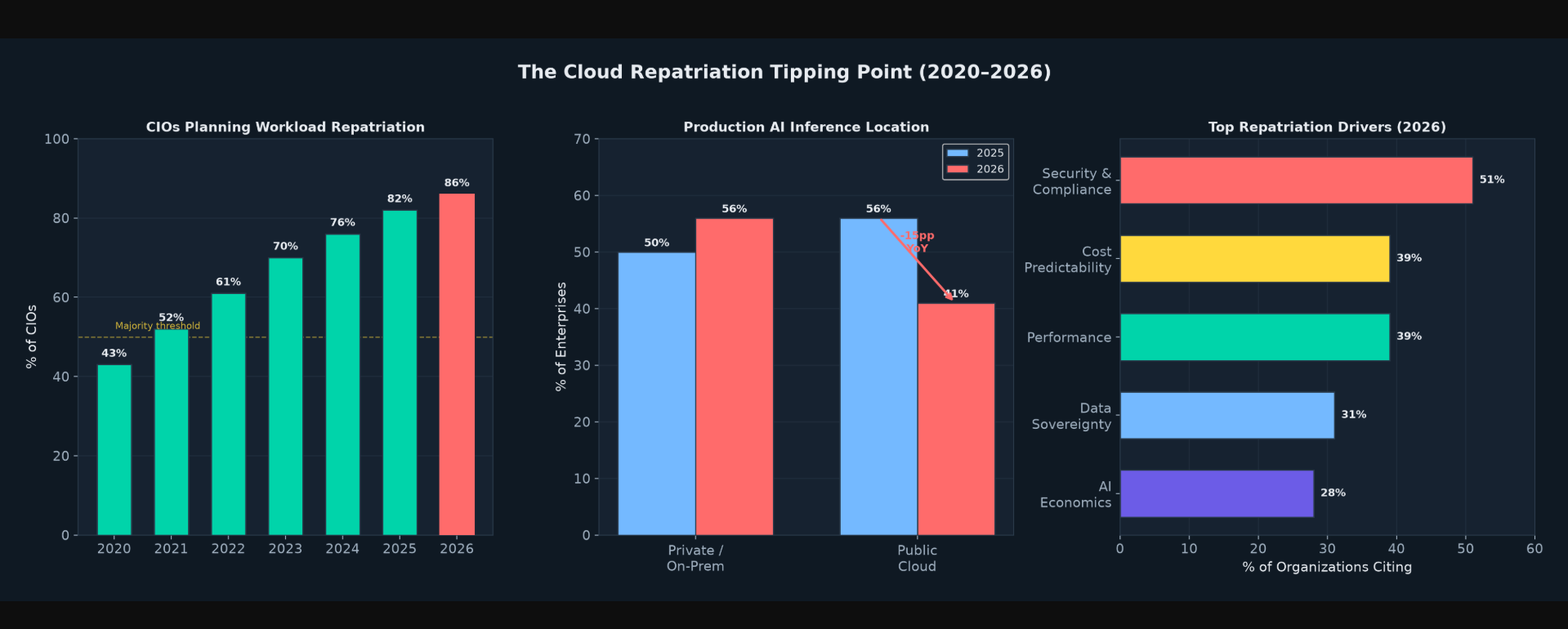
Figure 1: The Cloud Repatriation Tipping Point — CIO repatriation intent (2020–2026), production AI inference location shift, and top drivers. Sources: Barclays CIO Survey 2024, Broadcom Private Cloud Outlook 2026, IDC 2024.
Chapter 3: Why Manufacturing Is Leading the Exodus
Manufacturing enterprises are not just participating in cloud repatriation — they are leading it. The reasons are specific to the industry's operational characteristics:
Predictable, steady-state workloads. Unlike consumer internet companies with spiky traffic patterns, manufacturing plants run 24/7 with highly predictable compute loads. A quality inspection system processes a known number of images per hour based on line speed. A predictive maintenance model analyzes a known volume of sensor data. These workloads do not need cloud elasticity. They need reliable, low-cost, low-latency compute — exactly what on-premises infrastructure delivers best. The cloud's value proposition — "pay only for what you use, scale infinitely" — is meaningless when your usage is constant and your scale is fixed.
Massive data volumes at the edge. A single high-speed production line with multiple vision cameras can generate 5–10 terabytes of image data per day. A plant with ten lines generates 50–100 TB daily. Sending this data to cloud for inference or storage incurs egress fees that compound to millions of dollars annually. At $0.08–$0.12/GB, 100 TB/day translates to $8,000–$12,000 per day — $2.9–4.4 million per year — just to move the data, before any compute or storage charges.
Latency-critical operations. At 400 parts per minute, a production line has 150 milliseconds per part. At 600 ppm, the window shrinks to 100ms. Cloud inference round-trips of 200–500ms make cloud-based quality inspection physically impossible on high-speed lines. Edge inference at sub-10ms is not a nice-to-have — it is the only architecture that works.
Proprietary data that cannot leave the plant. Recipe formulations, process parameters, machine configurations, quality models, and production throughput patterns constitute the intellectual property that defines a manufacturer's competitive advantage. When this data traverses cloud infrastructure
解锁后续 88% 内容Unlock the Remaining 88% of Evaluations & the Decision Engine
The second half includes: a core solution cross-comparison matrix, a key parameter selection checklist, an implementation pitfalls guide, and a TCO & ROI calculator for mainstream approaches.
Get Your Custom Solution (View in Dashboard)