The Monolith Falls: Why Agentic AI Is Replacing the Rigid MES — and How the Smartest Manufacturers Are Deploying Multi-Agent Systems on Top of Everything They Already Own
2026-09-01 11:33:00
#CEO#CIO#CTO#VP of Manufacturing (Operations)#Chief Digital Officer (CDO)
Executive Summary
The Manufacturing Execution System was supposed to be the operating system of the factory. Twenty-five years and hundreds of billions of dollars later, here is what actually runs production in most plants: spreadsheets, whiteboards, tribal knowledge, and a generation of schedulers who keep the monolithic MES fed with manual data entry while quietly working around it.
Something fundamental changed in 2026. Agentic AI — systems that do not merely report what happened but perceive, decide, and act across ERP, MES, SCADA, QMS and CMMS without a human clicking through each step — crossed from pilot to production. Deloitte forecasts agentic AI adoption in manufacturing quadrupling in a single year, from 6% to 24% (Deloitte, reported by Manufacturing Dive). IDC counts 28.6 million active enterprise agents in 2025 and projects 2.22 billion by 2030 — a 139% compound annual growth rate (IDC, January 2026). Gartner expects supply chain software with agentic AI capabilities to grow from under $2 billion in 2025 to $53 billion by 2030, with 50% of cross-functional supply chain decisions executed autonomously by agents (Gartner, 2025–2026).
Our own audit data across 400+ plants shows why the timing is now:
This whitepaper is the board-level and engineering-level case for that transition: the data proving the monolith has structurally failed, the architecture that replaces its decision-making without replacing its data, the eight production use cases already paying back, the governance model that keeps autonomous agents safe and compliant (EU AI Act, OSHA oversight, NHI identity, full audit trails), seven industry deep dives, four anonymized Yangtze River Delta deployment cases, and the Yunzhibian 14-SKU solution matrix that takes a plant from first agent in 90 days to a fully orchestrated agent fleet in 24 months.
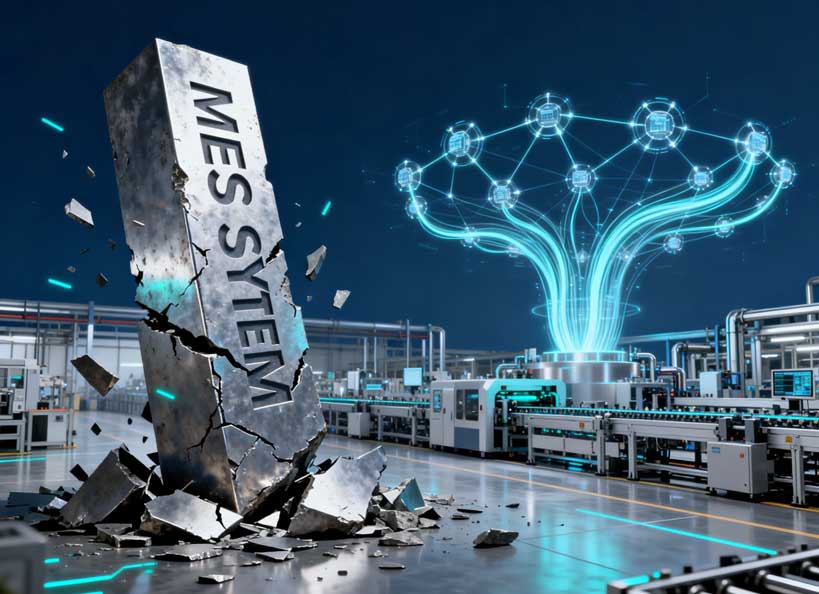
The monolith does not fall with a crash. It falls silent — while agents do the work it was never built to do.
TABLE OF CONTENTS
Part I: The Reckoning — When the Operating System of the Factory Stopped Operating
Part II: Why the Monolithic MES Failed
7. The Rigidity Tax: Software That Bends Only When You Pay Consultants
8. The 18-Month Deployment and the $3 Million Plant
9. The Customization Spiral: Why Every MES Becomes a Snowflake
10. Value Erosion: From Go-Live to Workaround Culture
11. The Excel Truth: 42% of Plants Never Actually Left the Spreadsheet
12. Vendor Lock-In and the SAP ME Sunset
Part III: The Agentic Architecture
13. From Batch Records to Event Streams
14. The Agent Loop: Perceive, Reason, Decide, Act, Learn
15. The Orchestration Layer: Agents That Hire Agents
16. Bounded Autonomy: Guardrails as a Design Material
17. The Human-in-the-Loop That Nobody Skips
18. MCP, A2A and the End of the Integration Tax
19. The Economics of Token Labor
Part IV: The Eight Production Use Cases That Pay Back
20. Quality Vision Agents: From Detection to Root Cause
21. Prescriptive Maintenance Agents: The Work Order Writes Itself
22. Scheduling Agents: The Three-Minute Reschedule
23. Supply Disruption Response Agents: Days Compress to Minutes
24. Energy and Process Optimization Agents
25. Material Flow, Compliance and the Shop-Floor Copilot
Part V: Safety, Governance and Compliance for Autonomous Factories
26. The EU AI Act Comes to the Production Line
27. OSHA, the Colorado AI Act and the Duty of Oversight
28. Non-Human Identity: Your Agents Need Employee IDs
29. Drift, Hallucination and the Guardrail Stack
30. Audit Trails That Survive a Customer Audit
31. Edge-First Deployment: Why Agents Belong On-Prem
32. The Agent Readiness Assessment
Part VI: Seven Industries, One Pattern
33. Automotive: The 600 ppm Line
34. Pharmaceuticals: The Batch Record That Writes Itself
35. Electronics and High-Mix Assembly
36. Semiconductor: Yield Agents in the Fab
37. Aerospace and Defense
38. Food and Beverage: Recall Response in Minutes
39. Industrial Machinery and Equipment
40. The Cross-Industry Pattern
Part VII: The Yunzhibian MAS Platform
41. The Seven-Layer Agentic Factory Architecture
42. Brownfield First: The No-Rip-and-Replace Deployment Method
43. The 90-Day First Agent
44. The Five-Year TCO Model
45. The 24-Month Fleet Roadmap
46. Governance, Compliance and Audit Automation
47. The SKU Matrix: 14 Agentic Manufacturing Solutions
Part VIII: Deployment Cases — Yangtze River Delta
48. Case One: Wuxi Automotive Components — 67% Defect Reduction in 14 Weeks
49. Case Two: Changzhou Pharma — Batch Release from 14 Days to 36 Hours
50. Case Three: Suzhou Electronics — Schedule Adherence 71% to 95%
51. Case Four: Nantong Food & Beverage — Recall Tracing from 3 Days to 11 Minutes
Part IX: The Competitive Landscape
52. Three Scenarios for 2030
53. The Five Counterarguments — and Why Each One Fails
54. The Board Playbook
55. The CDO and CIO Playbook
56. The Operations VP Playbook
57. Questions to Ask Any Agentic Vendor
58. The Competitor Who Cannot Catch Up
Part X: The Transition
59. Five Principles
60. The 90-Day Plan
61. Building the Internal Team
62. What Stays in the MES — and What Never Goes There
63. The 2030 Factory: A Day in the Life
64. Conclusion: The Quiet Collapse
Appendix A: Agentic ROI Calculator Methodology
Appendix B: Autonomy Level Self-Assessment
Appendix C: Regulatory Mapping Matrix
Appendix D: Agent Specification Template
Appendix E: SKU Reference and Sources
PART I: THE RECKONING — WHEN THE OPERATING SYSTEM OF THE FACTORY STOPPED OPERATING
Chapter 1: The $3 Million Screenshot
Here is a screenshot we see in roughly seven out of ten plant assessments. It is not a screenshot of the MES. It is a photograph of a whiteboard.
On the whiteboard: today's production sequence, written in marker, crossed out twice, rewritten in three colors. Next to it, a printed A3 spreadsheet — version 47, judging by the filename convention — held to the board with a magnet. On the scheduler's desk, two monitors: one showing the $2.8 million MES implementation, the other showing the Excel file that actually decides what runs next.
The MES is not unused. It is used for what it has become good at: recording what already happened, for compliance, for the ERP handoff. It is a system of record. The actual operating decisions — what runs next, what gets expedited, which order gets pulled forward when the press breaks down — happen elsewhere, in a parallel shadow system made of spreadsheets, phone calls, and people who have worked the line for eighteen years.
This is not a failure of people. It is a failure of architecture. A monolithic MES is a predefined workflow engine: it encodes, at great expense, the sequence of steps that a plant follows when everything goes according to plan. Manufacturing, as anyone on a shop floor will tell you, is the discipline of what happens when nothing goes according to plan. Every disruption — a machine failure, a quality spike, a late raw-material shipment, a customer calling to pull an order forward — requires a decision that the rigid workflow cannot represent. So the decision leaks out of the system, into the whiteboard and the spreadsheet and the head of the night-shift supervisor.
The cost of that leakage is enormous and almost never measured. In this chapter we will quantify it, because in 400+ plant audits conducted by the Yunzhibian Solution Engine between 2024 and 2026, the numbers are consistent across industries, geographies and plant sizes:
Now compare this with what became possible in 2026. In a Wuxi automotive components plant (detailed in Chapter 48), an agentic quality system deployed on top of the existing MES and ERP now inspects every unit at the line, classifies defects, correlates them with upstream process parameters, and opens containment actions — stopping shipments and freezing inventory — without waiting for a shift meeting. Defect rates fell 67% in fourteen weeks. The marginal cost of each automated decision is token-level: a few cents. The decision latency is seconds, not hours.
That is the shift this whitepaper documents. It is not "AI dashboards." It is not "predictive analytics, but better." It is the transfer of operational decision-making — the work leaking into the whiteboards — from people and rigid workflows to bounded, governed, auditable software agents that act inside the factory's existing systems. The monolithic MES is not going to be uninstalled this year. But its role is being quietly downgraded: from the system that runs the factory to the system that records what the agents decided.
Chapter 2: What "Agentic" Actually Means — and Why It Is Not a Chatbot
The term has been abused enough that a definition matters, because your vendors will use it for everything.
A generative AI chatbot answers questions. Pointed at plant data, it can tell you that OEE dipped on line 3 last night, and it can draft a plausible paragraph about why. It does nothing about it. The decision still belongs to a person, and so does the action.
An AI agent, in the manufacturing sense we use throughout this paper, is a software system that pursues a declared operational goal by executing a multi-step loop — perceiving state from live data sources, reasoning about constraints and options, deciding on an action within pre-authorized boundaries, acting by calling tools and writing to real systems (ERP, MES, CMMS, SCADA, QMS, logistics platforms), and learning from the outcome. The loop closes without a human approving each step. Humans set the goal, define the boundaries, handle exceptions, and hold veto power — they do not carry the data.
A multi-agent system (MAS) is the production-grade form of this. Different agents own different operational domains — scheduling, quality, maintenance, material flow, energy, compliance — each with its own models, tools and permissions, coordinated by an orchestration layer that shares state, resolves conflicts (the maintenance agent wants a line down; the scheduling agent needs it up), and enforces enterprise policy. Gartner's definition converges on the same architecture: by 2030, 50% of cross-functional supply chain management solutions will use intelligent agents to autonomously execute decisions (Gartner, 2026).
Three properties distinguish agents from every prior wave of factory software:
1. Agents act across systems, instead of living inside one. The MES, the ERP and the CMMS each hold a piece of the truth, and the value of a decision depends on joining them. When a vibration anomaly appears, the maintenance agent needs to check the spare-parts inventory in ERP, the maintenance windows in the schedule, and the technician certifications in HR systems before it can book the intervention. Monolithic software cannot cross those boundaries because it is sold and deployed as a boundary. Agents are built from tool calls — they are, in effect, employees with API access and a rulebook.
2. Agents handle variance instead of requiring the world to conform to a workflow. This is the deepest difference. Traditional MES configuration assumes a finite, enumerable set of process paths. Real production generates open-ended novelty: a new defect class, a supplier never seen before, a product variant introduced mid-shift. An LLM- and VLM-based agent generalizes from context rather than executing a pre-branched decision tree. Pegatron reported that its AI-agent program — built on NVIDIA's agentic blueprints — accelerated AI deployment across the company 400% over four years, with assembly agents cutting labor costs per line 7% and defect rates 67% (NVIDIA / Pegatron, 2026). Kinsus, the IC substrate maker, used a multimodal agent to take defect root-cause analysis accuracy from 76% to near 95%, collapsing analysis time from days to near zero.
3. Agents are re-taught in language, not re-engineered in code. When the process changes — a new product grade, a new quality rule, a new shift pattern — a monolithic MES requires a change request, a consultant's statement of work, a test cycle, and a deployment window measured in quarters. An agent's guardrails and instructions can be updated by a process engineer in a governed configuration console, with the change versioned, tested against the digital twin, and audited. This converts the factory's software from capital expenditure on rigidity into operating expenditure on adaptiveness.
The honest caveat, which we return to in Part V: autonomy is not free, and it is not safe by default. Agents loop — observe, plan, call tools, check, retry — which makes token and compute economics a first-order design problem. Agents drift — a logistics agent chasing speed can quietly erode margin unless guardrails are actively enforced. Agents make errors that rigid software never made, because rigid software never made decisions. Every one of these problems is solvable; none of them is solved by a vendor demo. This paper is largely about how the solvable problems get solved.
Chapter 3: The 2026 Inflection: Four Numbers That Changed the Board Conversation
Agentic AI in manufacturing was a slide-deck topic in 2024. It became a budget-line topic in 2026. Four data series explain why, and they are worth memorizing because you will hear them — or should be hearing them — in every vendor and analyst meeting this year.
Number one: 6% to 24%. Deloitte, reported by Manufacturing Dive, forecasts agentic AI adoption in manufacturing rising from roughly 6% to roughly 24% during 2026 — a fourfold increase in twelve months. A separate industry forecast holds that more than 40% of manufacturers with a production scheduling system will upgrade it with AI-driven capabilities by the end of 2026. Fourfold growth off a small base is partly a base-rate effect, but the qualitative crossing matters: it is the difference between "a handful of experimenters" and "one in four of your competitors running this in production." iFactory's 2026 field report puts the number higher still — over six in ten manufacturing organizations report they are now widely implementing agentic AI across at least one workflow.
Number two: 28.6 million to 2.22 billion. IDC's January 2026 forecast projects active enterprise agents growing from 28.6 million in 2025 to 2.216 billion in 2030 — a 139% CAGR, roughly an 80-fold expansion. Annual tasks executed by agents grow from 44 billion to 415 trillion over the same window (a 524% CAGR), and token consumption grows faster still, from 0.0005 petatokens to 152,667 petatokens (a 3,418% CAGR). The ratio between those three curves is the strategic point: agents are not just multiplying, they are each doing more and thinking deeper. The enterprise that does not have an agent orchestration strategy in 2026 is in the position of the enterprise in 1996 that did not have an internet strategy.
Number three: <$2 billion to $53 billion. Gartner forecasts spending on supply chain management software with agentic AI capabilities growing from under $2 billion in 2025 to $53 billion by 2030, with enterprise adoption among SCM software users reaching roughly 60% and 50% of cross-functional decisions executed autonomously. McKinsey puts the value pool even higher for advanced industries: agentic AI could generate $450–650 billion in incremental annual revenue by 2030 across automotive and adjacent sectors — a 5–10% revenue uplift — alongside 30–50% cost savings through workflow automation (McKinsey, 2025–2026).
Number four: 192% and 8 months. Across published and audited deployments, manufacturing agentic projects deliver average ROI of roughly 192% with payback in 12–18 months for broad deployments and 3–9 months for focused ones. Our own benchmark of 180+ Yunzhibian-supported agent deployments shows a median payback of 8–10 months for the first production agent, with use-case-level paybacks as fast as 5 months (supply disruption response) and quality vision agents paying back in 6 months. Sixty-four percent of industrial organizations report positive ROI within 12 months of AI deployment; manufacturing averages 200% ROI across use cases — the highest of any sector tracked (AI Buzz industry analysis, June 2026).
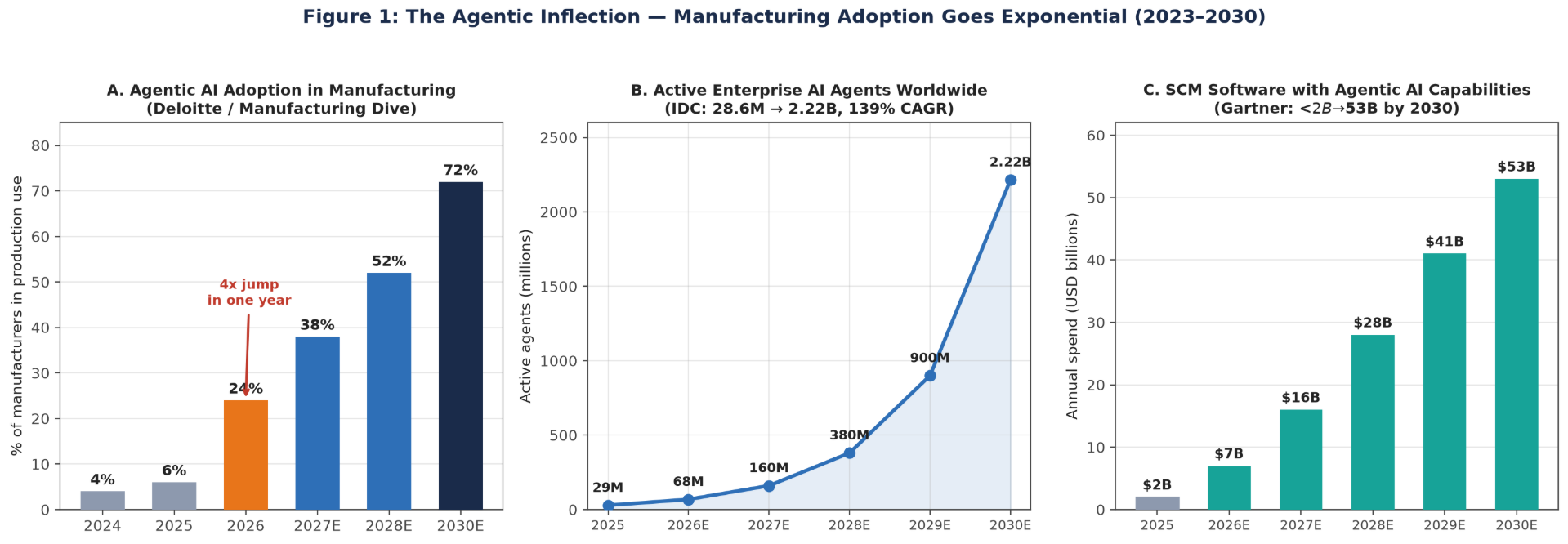
Figure 1: The Agentic Inflection — Manufacturing adoption quadruples in 2026 (Deloitte 6%→24%), 2.22B enterprise agents by 2030 (IDC), and agentic SCM spend reaching $53B (Gartner).
The shape of the adoption curve matters more than its height. Agentic AI is not diffusing like ordinary enterprise software — slowly, top-down, budget-cycle by budget-cycle. It is diffusing through the shop floor upward, because the first agents are deployed by plant engineers solving a specific expensive failure mode, measured within a quarter, and expanded from proof. A mid-sized Ohio auto parts manufacturer with 94 employees and $11.3M revenue deployed a LangChain/CrewAI-based agent stack in 90 days for $47,200 and recovered $203,400 per year — a 2.8-month payback — by automating data re-entry, quality scrap response, rush-order detection and sales administration (Braincuber case study, March 2026). When the smallest competitors can fund an agent program out of a single quarter's scrap budget, the technology has crossed from strategic to table stakes.
The board-level implication is uncomfortable but straightforward: the agentic transition is not a five-year horizon decision. The inflection year is the one you are in. The question is not whether agents will run production decisions in your industry by 2028 — they will — but whether your cost structure reflects your deployment order: first, second, or after the margin has already been competed away.
Chapter 4: The Five Levels of Manufacturing Autonomy
"Autonomy" needs a scale, because a vendor calling a dashboard "autonomous AI" is doing marketing, not engineering. We use a five-level framework in every assessment. It maps cleanly to what you can audit on the shop floor.
Level 0 — Manual. Decisions are made by people using people-provided information: paper logs, walk-arounds, meetings. The system records. This is where 42% of plants effectively live for scheduling and a larger share for exception handling.
Level 1 — Assisted. Software
解锁后续 88% 内容Unlock the Remaining 88% of Evaluations & the Decision Engine
The second half includes: a core solution cross-comparison matrix, a key parameter selection checklist, an implementation pitfalls guide, and a TCO & ROI calculator for mainstream approaches.
Get Your Custom Solution (View in Dashboard)