The 2026 Connected Worker Whitepaper: The Silver Tsunami — AI Co-Pilots for Junior Techs to Stop Knowledge Loss
2026-10-28 12:35:00
#CEO#CHRO#VP of Manufacturing#COO#Director of EHS
Executive Summary
For twenty years, manufacturing digitization argued about machines and software while quietly ignoring the most fragile component in the plant: the human who knows why the line actually runs. That component is now leaving.
The people who nursed thirty-year-old equipment through its undocumented quirks — the technicians who can diagnose a gearbox by its sound, who know which interlock was bypassed in 2011 and why, who can complete a changeover in twenty minutes where the written procedure takes two hours — are reaching retirement in the largest concentrated exit of skilled industrial labor in modern history. The industry calls it the silver tsunami. In our field work across 360+ advanced-manufacturing and R&D sites in North America and Europe during 2025-2026, it is not a forecast. It is the shift schedule.
Behind them stands a generation of younger workers who are, contrary to lazy stereotype, neither unskilled nor unwilling — but who categorically refuse to learn the way the work was supposedly taught: by hunting a 500-page static manual, by memorizing legacy PLC dialects for their own sake, by absorbing knowledge through years of silent osmosis. They learn from video, from search, from context-aware guidance in the moment they need it. Give them a five-hundred-page PDF and they will disengage. Give them an AI co-pilot that shows the right step on a rugged device at the point of work, and they outperform.
The result is a structural collision: the people with the knowledge are leaving, the people replacing them learn differently, and the traditional answer — "pair the new hire with the veteran for a few years" — assumes a stable workforce and a multi-year runway that no longer exists. This whitepaper is about the only answer we have seen work at scale: Connected Worker 2.0, a human-centric model in which ambient AI captures veteran expertise and serves contextual, validated guidance to junior technicians at the point of work — while the qualified human remains the accountable decision-maker at every step.
What the field data shows
The figures below are drawn from the site audit set described in our methodology notes. They are directional ranges for a typical advanced-manufacturing site rather than guarantees for yours; Appendix D shows how to recompute every number against your own workforce and loss records.
表格
| Finding | Field result | Why it matters to the board |
|---|---|---|
| Senior technicians eligible to retire by 2030 | ~42% | Nearly half the irreplaceable expertise is on a dated exit ramp |
| Critical operating knowledge held only in people's heads, unrecorded | ~64% | When they walk, the knowledge walks with them |
| Junior technicians who feel ready to work independently | ~29% | The bench behind the retirees is not ready in their own estimation |
| Fortune 500 manufacturers piloting or scaling frontline AI co-pilots | 60% | Augmentation is already mainstream, not experimental |
| Reduction in time-to-competence for new hires after a mature program | ~50-55% | The single biggest lever against the retirement wave |
| Reduction in expertise-driven errors and incidents | ~60% | Junior workers guided to veteran-level outcomes |
| Typical program investment / year-one value / payback | ~$380K / ~$700K / ~8 months | Sub-year payback on a single high-risk area |
Five arguments carry this paper:
How to read this whitepaper
Part I diagnoses the talent cliff. Part II sizes the cost of the knowledge drain. Part III explains why manuals and a generation of "knowledge management" failed. Part IV defines the six-layer Connected Worker 2.0 stack and the human-authority line. Part V gives the six-step build-and-deploy method. Part VI builds the economic case. Part VII is a worked day-in-the-life walk-through. Part VIII presents four field cases. Parts IX-XI cover governance, organization, and a 90-day start with a five-year view. Parts XII-XIII are the engineering deep dive and the leadership playbook. Appendices A-F provide the SKU catalog, knowledge-at-risk library, validation checklist, ROI model, glossary, and RFP language.
A note on tone and evidence. We have an opinion and we are not hiding it: static documentation and "wait and hope" succession planning are dead, and the future of frontline manufacturing belongs to human-centric, guardrailed AI augmentation that respects the worker. But every recommendation here is one we would stake an engineering and an HR reputation on, and we show the assumptions so you can disagree with the math rather than the marketing.
PART I — THE TALENT CLIFF
1. The retirement wave is not coming; it arrived
Every plant manager over a certain age knows the conversation. You walk the floor and realize that the four people who truly understand the boiler house, the legacy packaging line, and the undocumented control logic are all within five years of retirement — and the people assigned to learn from them keep turning over or never get formally assigned at all. For years this was treated as a distant problem, something the next org chart would solve. The calendar has now caught up. The wave the industry has been warned about for fifteen years is the current shift schedule.
2. It is worse than the headcount numbers suggest
A superficial workforce plan sees a retirement percentage and assumes the fix is recruitment: replace one senior technician with one or two younger hires, perhaps at lower cost. This misses the actual asset being lost. The senior technician is not interchangeable labor; they are a database of site-specific causal knowledge — which alarms are real, which suppliers' parts actually fit, how this specific machine deviates from its nominal design, what the sound before the failure sounds like. Much of this was never written down, some of it was actively contrary to the official procedure, and none of it transfers through a job title.
3. CHART1
4. Reading the cliff
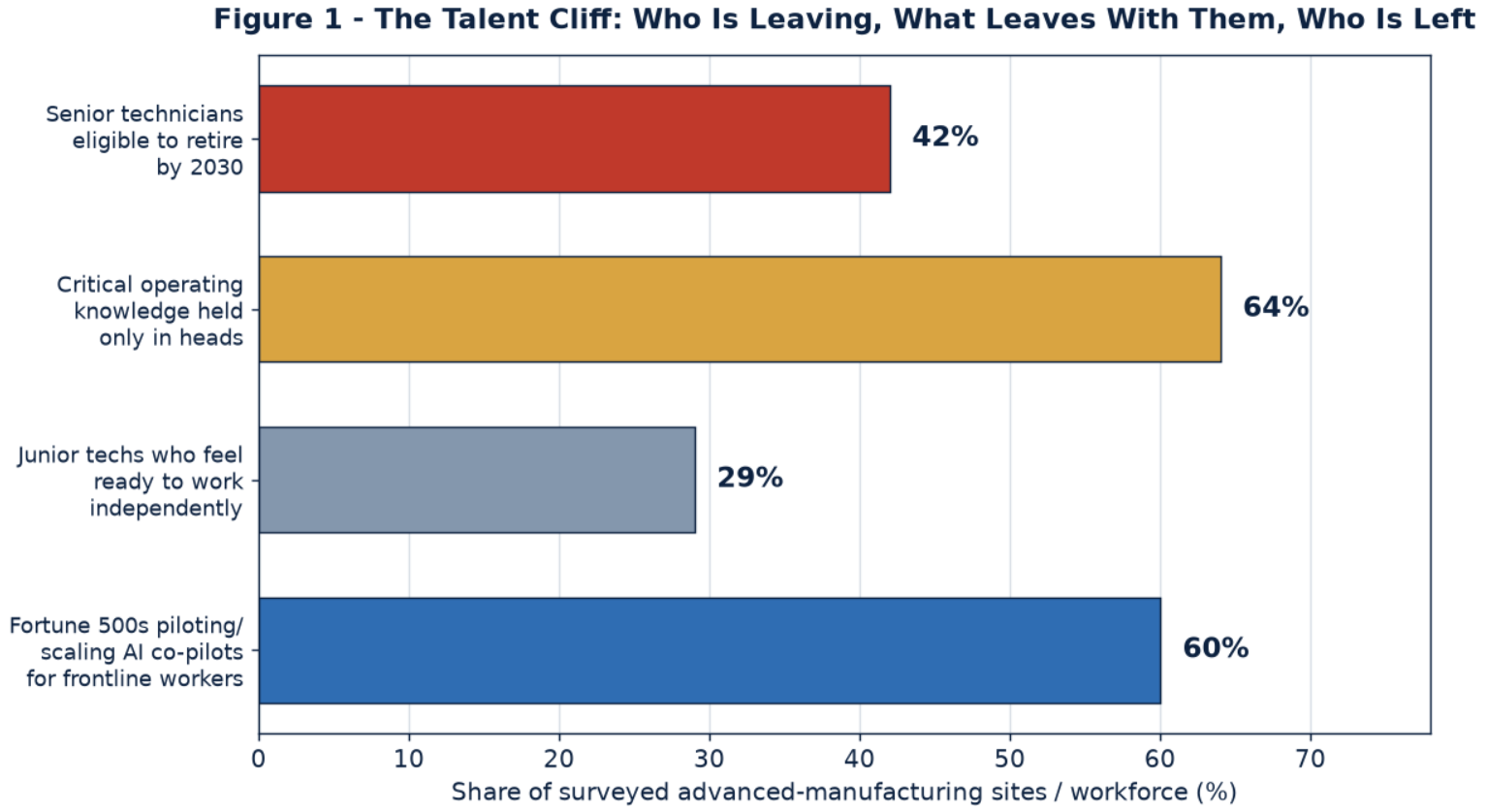
Figure 1 makes the asymmetry visible. Roughly forty-two percent of senior technicians are retirement-eligible within the planning window; nearly two-thirds of the knowledge that keeps operations running exists only in their heads; and barely a quarter of the juniors who are supposed to inherit the work feel ready to do it independently. The final bar is the strategic response already underway: sixty percent of large manufacturers are piloting or scaling AI co-pilots for frontline workers. They are not doing this because AI is fashionable; they are doing it because the demographic math leaves no alternative that preserves the knowledge.
5. Why the knowledge is invisible until it is gone
Tacit knowledge has a dangerous property: its full value is revealed only at the moment it is needed and absent. A plant can run for years without noticing how much depends on one person, because that person quietly prevents problems rather than heroically solving them. Their contribution is measured in incidents that never happened — which, by definition, produce no records and no metrics. When they retire, the first six months may look fine; the knowledge gap surfaces as a sequence of surprises: a changeover that now takes three times as long, a fault nobody can diagnose, a bypassed interlock that a new contractor does not know about, an injury that the veteran would have prevented with a single sentence.
6. The generational mismatch in how work is learned
The incoming workforce is not the problem it is sometimes painted as. Junior technicians are typically digitally fluent, comfortable with video and voice interfaces, and strong at finding answers quickly — but they have been formed by an information environment where knowledge is searchable, contextual, and delivered on demand. Asking them to internalize a five-hundred-page static manual or to spend years in passive apprenticeship before being trusted clashes with every expectation they bring from the rest of their lives. The gap is not willingness; it is the mismatch between how the knowledge is offered and how this generation actually learns. Connected Worker 2.0 meets them where they already are.
7. The double bind of the modern plant
Three pressures compound each other. Equipment is simultaneously aging (carrying more undocumented quirks) and becoming more software-driven (demanding new skills the veterans may not hold). Margins are too thin to carry long apprenticeship programs and expensive mistakes. And the labor market for skilled technicians is tight enough that overworking the remaining veterans accelerates their exit. Doing nothing is not the stable option; it is an active bet that the next retirement will not coincide with the next catastrophe.
8. What this paper is and is not
This is not a paper about replacing workers with AI, monitoring keystrokes, or building the lights-out factory. It is about capturing the knowledge of the people leaving, compressing the apprenticeship of the people arriving, and giving every worker an expert assistant at the point of work while keeping the human fully in authority. The technology is the means; the preserved capability, the safer floor, and the retained workforce are the outcome.
PART II — SIZING THE COST OF THE KNOWLEDGE DRAIN
9. The knowledge gap is a P&L and a safety line
When a veteran leaves, the cost shows up across functions that never consolidated it: extended troubleshooting time charged to maintenance, scrap and rework charged to quality, downtime charged to operations, contractor premiums charged to procurement, and — most gravely — safety incidents charged to EHS and, sometimes, to people. Treating the knowledge drain as an abstract HR risk lets leadership underweight a number that, fully assembled, is large enough to fund the entire solution many times over.
10. The fully-loaded cost of an expertise-dependent event
A defensible cost for a single event caused by missing or misapplied expertise includes:
表格
| Cost component | What it captures |
|---|---|
| Extended troubleshooting | Time spent by multiple staff guessing what the veteran would have known in minutes |
| Unplanned downtime | Lost production while a knowledge-dependent fault is diagnosed |
| Rework and scrap | Errors made during an unfamiliar procedure or changeover |
| Contractor / expert call-out | Premium for external specialists or flying in a retired expert |
| Training and shadowing drag | Lost productivity during an over-long, unstructured ramp-up |
| Safety and environmental | Incident, injury, spill, or regulatory exposure from a missed cue |
| Turnover reinforcement | Juniors leaving because they feel unsupported and set up to fail |
11. CHART2
12. Reading the industry spread
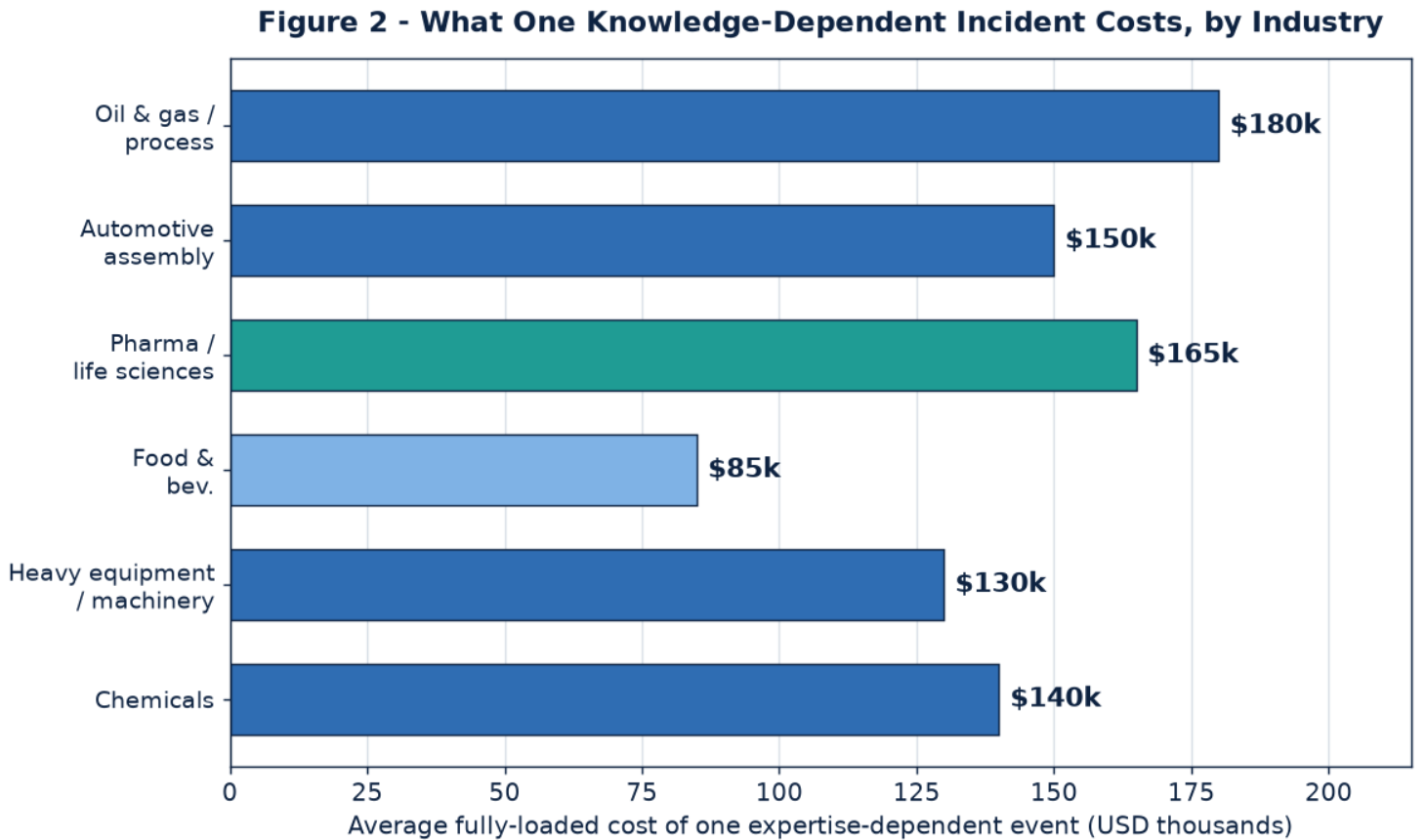
Figure 2 shows why use-case selection begins with the cost of being wrong, not with technology novelty. In process industries, oil and gas, and life sciences, a single knowledge-dependent event — a misdiagnosed fault, an incorrect lockout sequence, a deviation from the real (not written) procedure — can run into six figures of direct cost before the safety consequences are counted. In food and lighter discrete manufacturing the per-event cost is lower but the frequency is higher, so the annualized exposure is comparable. The first deployment should target the tasks where the product of expertise dependency, frequency, and cost or severity of error is highest — formalized in Figure 7.
13. The slow-burn cost: time-to-competence
The largest recurring cost is often the least visible: the long, unstructured ramp from new hire to independently competent technician. Under the traditional apprenticeship model this can take years, during which the junior is a net consumer of senior time, works slowly, and makes a background rate of errors. Compressing that ramp by half — which is what a mature co-pilot program achieves — simultaneously releases senior capacity, accelerates output, reduces the error tail, and improves retention because competent workers who feel supported do not leave. On a single shift team the annualized value of halving time-to-competence can exceed the cost of the whole program.
14. The retention feedback loop
Knowledge loss and turnover reinforce each other. Juniors who are expected to perform complex work without support fail, feel blamed, and leave; the resulting churn concentrates even more knowledge on the shrinking veteran population; overworked veterans retire earlier or take their knowledge elsewhere; and the cycle worsens. A co-pilot interrupts this loop by making a junior successful on day one in a bounded way, which builds confidence and retention. The program is therefore not only a knowledge-capture mechanism; it is a recruiting and retention tool for a generation that expects, and will choose employers on, the quality of the tooling that supports their work.
15. The board framing
For a CEO or CHRO, the clean framing is this: the knowledge drain is a self-inflicted, partially preventable loss that the organization is already paying for, invisibly, in slow ramps, repeated mistakes, contractor premiums, and near misses. Connected Worker 2.0 does not invent a benefit; it captures knowledge that is otherwise about to walk out the door and converts a multi-year, expensive apprenticeship into a guided, measured, and repeatable ramp — with receipts.
PART III — WHY MANUALS AND "KNOWLEDGE MANAGEMENT" FAILED
16. The documentation graveyard
Most large manufacturers have already attempted the obvious answer, more than once. They hired technical writers. They produced thick standard operating procedures. They bought knowledge-management portals and document-control systems. They scanned the paper binders into PDFs. And today the five-hundred-page manual sits untouched in a locker or a portal nobody opens, while the actual procedure is still a verbal handoff on the floor. Understanding why those attempts failed is essential, because an AI co-pilot that merely serves the same dead documents in a chat window will fail identically.
17. Failure one: the written procedure is not the real procedure
In any mature plant there are two procedures: the official one in the binder, and the one that actually works, refined over decades around the machine's real behavior, its undocumented workarounds, its worn tooling, and its specific history. The official procedure may be technically correct but practically slow or subtly wrong; veterans follow the real one and cannot always articulate why. Documentation projects capture the official procedure because that is all anyone will write down. The knowledge that matters — the difference between the two — is precisely what was never captured.
18. Failure two: knowledge is delivered nowhere near the moment of need
A manual is a static artifact consulted before or after work; the need for expertise arises during work, at the machine, often under time pressure, with grease on the gloves. A junior staring at an unfamiliar fault at 2 a.m. will not walk to an office, locate the correct revision of a 500-page document, and read section 7.4. They will guess, call someone, or improvise. Knowledge that is not present at the point of work, in the exact context of the work, might as well not exist. This is the fatal disconnect that portals never solved.
19. Failure three: text cannot carry sensory and procedural knowledge
Much of veteran expertise is not propositional ("set torque to X") but perceptual and motor ("when the sound changes and the vibration settles, it's seated"). Text and even photographs convey this poorly. Video, annotated vision, voice, and — critically — contextual AI that interprets what the worker is seeing and doing in real time can carry it. A documentation strategy limited to text is structurally incapable of transferring the part of the knowledge that prevents the most failures.
20. Failure four: documents rot and nobody maintains them
Static documentation decays the moment it is published. Machines are modified, parts substituted, procedures improved, and the document is not updated; within a few years it is demonstrably wrong often enough that workers learn not to trust it. Without a living feedback loop from the floor back into the knowledge base, every documentation project becomes a snapshot that ages into misinformation. The system needs the people doing the work to continuously correct and enrich it, which only happens if contributing is effortless and visibly valuable to them.
21. Failure five: it ignored how the new generation learns
Finally, the old model assumed a learner who would patiently absorb a corpus of text through hierarchy and time. That learner is not the workforce of 2026. Younger technicians learn by doing, by watching short-form video, by searching for the specific answer to the current problem, and by receiving immediate feedback. A knowledge system designed for a different learner will be rejected however comprehensive it is. The medium and the moment are part of the knowledge, not optional packaging.
22. CHART3
23. The maturity spectrum, honestly located
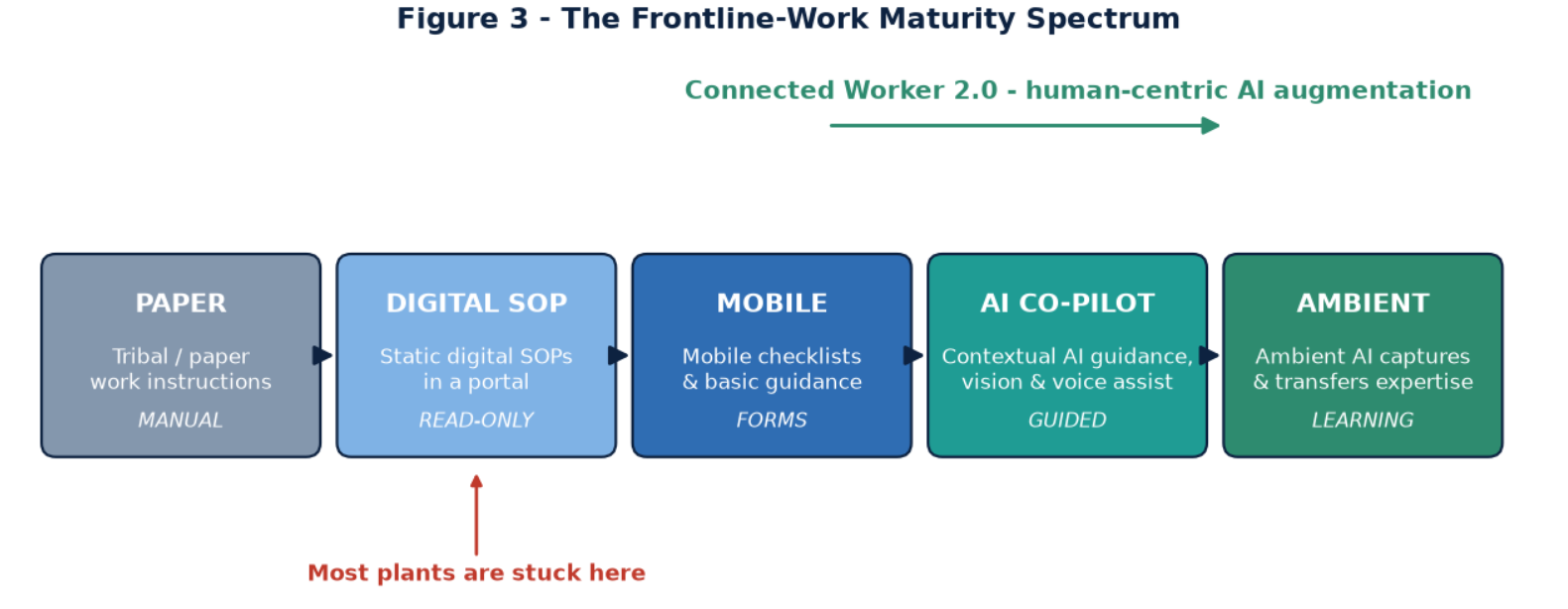
Figure 3 places a typical plant on the frontline-work spectrum. Most have moved past pure paper and many have invested in static digital SOPs or mobile checklists — and then stalled there, at read-only documentation that repeats the old failures on a nicer screen. The two zones to the right are where the knowledge drain is actually addressed: the AI co-pilot, which delivers contextual, multimodal guidance at the point of work, and ambient capture, which records how veterans actually perform and turns tacit skill into reusable, living knowledge. Reaching those zones is the subject of the rest of this paper.
24. The conceptual shift: from documents to guidance
The reframing that separates successful programs from failed ones is to stop thinking about knowledge as a library and start treating it as a service delivered in context. The goal is not a better manual; it is the right next instruction, for this worker, on this asset, in this situation, presented hands-free at the instant it is needed, validated against what a veteran would do, and continuously improved by the outcome. That is a fundamentally different system — and it is exactly what the six-layer architecture in Part IV is designed to deliver.
PART IV — THE SIX-LAYER CONNECTED WORKER 2.0 STACK
25. Architecture philosophy: assist at the edge, keep the human in authority
Three commitments shape the stack. Meet the worker where the work is: guidance must be available on rugged, often hands-free devices at the machine, including in environments with no reliable connectivity. Be contextual, not generic: the system must know which asset, which work order, which step, and which skill level it is supporting. Never displace accountability: the AI proposes and verifies; the qualified worker decides and acts, and low-confidence situations always escalate to a human. That boundary is not a limitation to engineer away; it is the entire safety a
解锁后续 88% 内容Unlock the Remaining 88% of Evaluations & the Decision Engine
The second half includes: a core solution cross-comparison matrix, a key parameter selection checklist, an implementation pitfalls guide, and a TCO & ROI calculator for mainstream approaches.
Get Your Custom Solution (View in Dashboard)