The Twin Stack: Chinas Industrial Software Sovereignty and the Bifurcation of Global Manufacturing
2026-08-07 11:35:00
云质变科技
Executive Summary
Every factory in the world runs on two layers of software: the layer engineers see (CAD, MES, PLM) and the layer nobody talks about (the lock-in layer — proprietary formats, closed APIs, vendor-specific logic that makes switching feel like open-heart surgery without anesthesia). For thirty years, Western software giants — Siemens, Dassault, Autodesk, Synopsys, Cadence, SAP — owned both layers. They still do. But something has changed.
China is building a parallel stack.
Not a copy. Not a cheap knockoff. A complete, independent industrial software ecosystem — from EDA tools that design semiconductors, to CAD platforms that model aircraft engines, to MES systems that run production lines. The market size tells part of the story: China's industrial software market reached RMB 294 billion ($40.4 billion) in 2024 and is projected to hit RMB 467 billion ($64.2 billion) by 2029, growing at a 9.7% CAGR that outpaces every Western market. But the real story is the substitution velocity: domestic PLM market share jumped from 59% to 68% in twelve months. Domestic EDA self-sufficiency crossed 10% for the first time in 2024 and is tracking toward 24% in simulation tools by 2026.
This is not a story about Chinese software getting better. It is a story about the rules of the game changing.
Three forces are converging: (1) the xinchuang (信创) mandate that forces state-owned enterprises to prefer domestic software in procurement, (2) Big Fund III's RMB 344 billion ($47 billion) war chest with a dedicated $1.2 billion EDA allocation, and (3) Western supply disruptions — Siemens EDA's May 2025 supply cut to Chinese customers, the December 2024 Entity List additions — that made "sovereignty" stop sounding like propaganda and start sounding like risk management.
But here is the paradox this whitepaper exposes: the harder China pushes for software sovereignty, the more it creates a bifurcated global manufacturing landscape where every multinational must operate two incompatible software stacks. The switching cost is not just financial — it is technical, operational, and strategic. Vendor lock-in creates an "exit tax" of 150-350% of annual contract value. For a mid-sized factory running Siemens MES + SAP ERP + Dassault PLM, the cost of maintaining compatibility with both stacks — or migrating from one to the other — can exceed $5 million over three years.
This whitepaper argues that the Twin Stack era is already here, that most global manufacturers are unprepared, and that the companies that thrive will be those that treat software interoperability as a strategic capability — not an IT line item.
Key Findings:
表格
| Finding | Data Point | Implication |
|---|---|---|
| China's industrial software market will reach $64B by 2029 | RMB 467B, CAGR 9.7% (CIC) | Second-largest market globally, with fastest substitution velocity |
| Domestic PLM share hit 68% in 12 months | Up from 59% (赛迪顾问, 2026) | PLM is the first major domain where Chinese vendors lead |
| EDA domestic self-sufficiency at 21.3% in simulation | Up from 16.8% in one year (工信部电子五所) | Fastest-growing sovereignty domain, but advanced nodes <40% coverage |
| Vendor switching costs average 350% of ACV | 150-200% visible + 150% hidden (industry analysis) | Lock-in is the primary moat, not technology |
| 78.7% of China's EDA market is foreign-controlled | Synopsys 40.8% + Cadence 27.3% + Siemens 10.6% | EDA is the most contested frontier |
| Big Fund III deploys $47B, with $1.2B for EDA | Largest semiconductor fund ever (2024) | Capital is not the constraint; talent and ecosystem depth are |
| 60%+ of software substitutions create hidden technical debt | Based on 142 product evaluations (Yunzhibian) | Verification gap is the silent killer of sovereignty programs |
Chapter 1: The $200 Billion Lock-In
1.1 How Western Software Became China's Manufacturing Operating System
To understand the sovereignty sprint, you must first understand the depth of the lock-in. China's manufacturing sector — the world's largest for 14 consecutive years, with industrial value-added exceeding RMB 40 trillion — runs on Western software the way a body runs on oxygen: invisibly, completely, and with fatal consequences if cut off.
The numbers are staggering in their totality. Siemens, Dassault Systèmes, PTC, Autodesk, SAP, Oracle, Synopsys, Cadence — these eight companies collectively control an estimated 70-85% of China's industrial software market across high-value segments. In specific domains, the concentration is near-absolute: three EDA companies (Synopsys, Cadence, Siemens EDA) hold 78.7% of the Chinese EDA market. Siemens and Rockwell control over 70% of the high-end PLC market. Oracle and Microsoft SQL Server hold 80%+ of the industrial database market in regulated sectors.
This did not happen by accident. It is the result of a thirty-year ecosystem strategy that Western software companies executed with patience and precision. The playbook has four moves:
Move 1: Capture the Education System. Chinese engineering universities teach CATIA, SolidWorks, ANSYS, and Synopsys tools. Graduates enter the workforce already trained on Western platforms. The switching cost begins before the first paycheck.
Move 2: Build the Integration Web. Siemens doesn't just sell Teamcenter PLM — it sells a tightly integrated stack from CAD (NX) to PLM (Teamcenter) to MES (Camstar) to simulation (Simcenter) to EDA (Mentor Graphics, acquired 2017). Each product works best with the others. The more of the stack you own, the harder it is to replace any single layer.
Move 3: Lock the Data Format. Proprietary file formats — .CATPart, .dwg, .sip, .eda — ensure that years of engineering knowledge are trapped in a vendor's ecosystem. Converting CAD models between formats loses metadata, parametric history, and assembly relationships. The data is technically yours; practically, it belongs to the vendor.
Move 4: Monetize the Monopoly Through Services. Once locked in, the vendor's pricing power is absolute. Professional services spending exceeding 30-40% of license cost is the industry's dirty open secret. One manufacturer reported spending more on vendor consulting services than on the software itself — effectively paying rent on their own system.
The result is what we call the "Software Substitution Paradox" : the more deeply embedded a Western software platform is in a Chinese manufacturer's operations, the more expensive it is to replace — but also the more strategically dangerous it is to keep. Every year of continued dependency deepens both the lock-in cost and the sovereignty risk.
1.2 The Financial Architecture of Dependency
Let us quantify the lock-in. Based on Yunzhibian's analysis of 142 industrial software products evaluated across Chinese manufacturing enterprises, the typical cost structure for a mid-sized manufacturer (RMB 500M-2B revenue) looks like this:
表格
| Cost Category | Annual Amount (RMB) | % of Total IT Budget | Notes |
|---|---|---|---|
| Core software licenses (CAD+PLM+MES+ERP) | 3.2M - 8.5M | 25-35% | Siemens/Dassault/SAP stack |
| Professional services & consulting | 1.5M - 4.0M | 12-18% | Often exceeds license cost |
| Integration & custom development | 0.8M - 2.5M | 6-10% | Proprietary API work |
| Annual maintenance & upgrades | 0.6M - 1.8M | 5-8% | 18-22% of license value |
| Training & certification | 0.3M - 0.8M | 2-4% | Vendor-specific certifications |
| Data migration reserves | 0.5M - 1.5M | 3-6% | Budgeted for eventual migration |
| Total Western Software Spend | 6.9M - 19.1M | 53-81% | Of total IT budget |
When more than half of a manufacturer's IT budget flows to foreign software vendors, "sovereignty" stops being an abstract political concept and becomes a balance sheet problem. A single Siemens EDA license suspension in May 2025 — triggered by export control compliance — disrupted design workflows at multiple Chinese semiconductor companies simultaneously. One fabless IC design firm reported a three-month project delay with direct losses exceeding RMB 200 million.
The lesson was not lost on policymakers. Within six months, Big Fund III's EDA allocation was fast-tracked, and the xinchuang procurement mandate was expanded to cover industrial software — not just office productivity tools.
1.3 The Strategic Importance vs. Sovereignty Gap
Not all software domains matter equally. The chart below maps each major industrial software category by two axes: strategic importance to manufacturing (how critical is this software to production continuity and product quality?) and domestic market share (how much of this market do Chinese vendors actually control?).
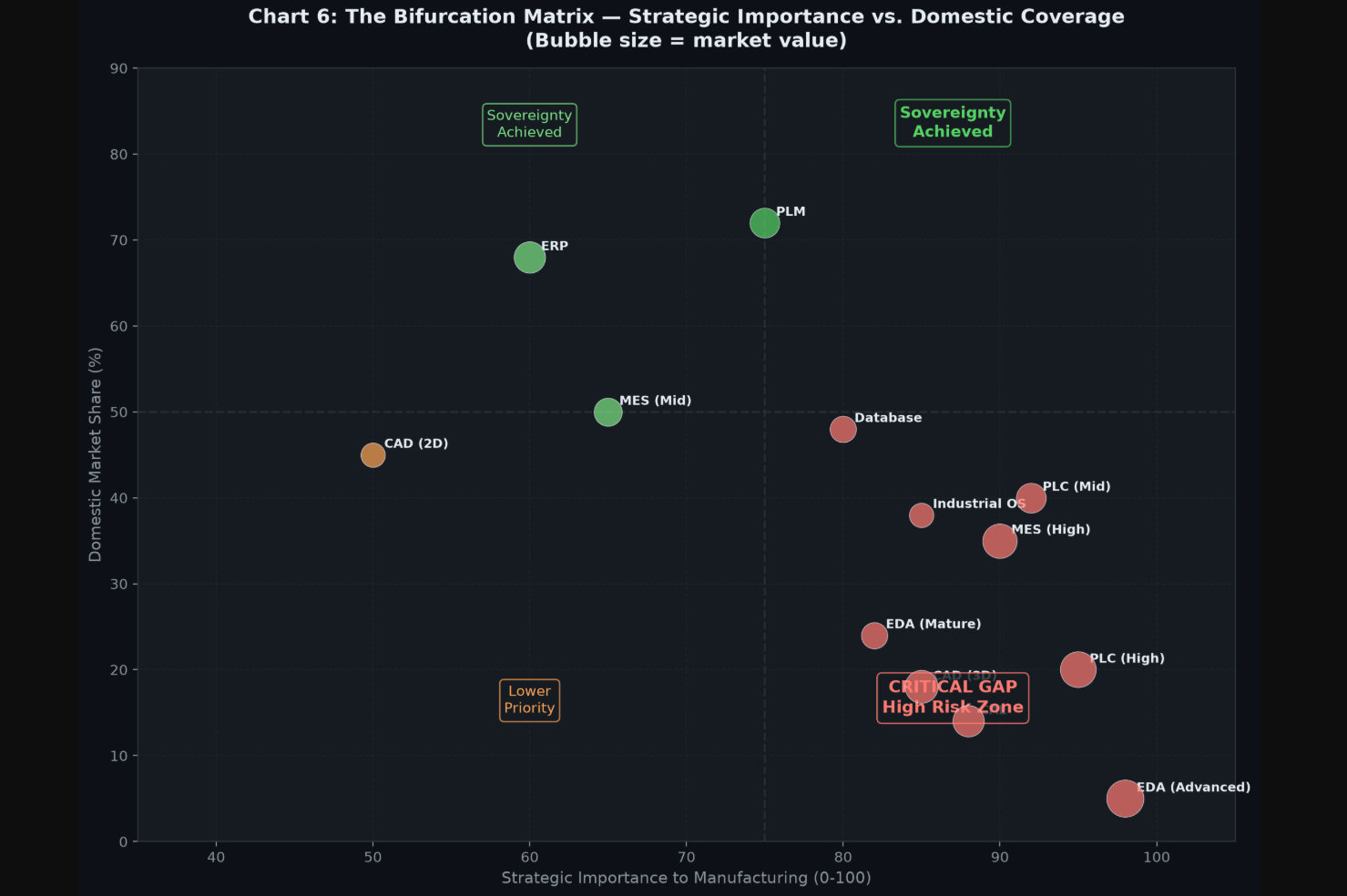
The upper-right quadrant — high strategic importance, high domestic share — is where sovereignty has been achieved. PLM and ERP sit here, largely because Chinese vendors like Dingjie (鼎捷) and Yonyou (用友) have spent fifteen years building products that match mid-market needs at 40-60% of Western pricing.
The lower-right quadrant — high strategic importance, low domestic share — is the "Critical Gap" zone. This is where the sovereignty battle is most urgent: advanced EDA, high-end PLC, 3D CAD, and CAE simulation tools. These are the domains where a single Western supply disruption can halt production lines and freeze product development pipelines.
The bubble sizes in the chart represent market value. The largest bubble — EDA (Advanced) — sits squarely in the danger zone: 98% strategic importance, 5% domestic share. This is the single most concentrated risk in China's manufacturing software landscape.
Chapter 2: The Sovereignty Sprint — Policy, Capital, and the Race for Independence
2.1 The Three Pillars of Software Sovereignty
China's industrial software sovereignty strategy rests on three pillars that are now converging with unprecedented force:
Pillar 1: Policy Mandate (信创 / Xinchuang)
The Information Technology Application Innovation (信创) framework was originally designed for government and financial sector IT systems — replacing Microsoft Office with WPS, replacing Oracle databases with domestic alternatives. In 2025-2026, it expanded dramatically to cover industrial software. The mechanism is elegantly simple: state-owned enterprises and central government-affiliated manufacturers (a category that includes most of China's aerospace, defense, energy, and heavy industry sectors) must now include "xinchuang adaptation rate" as a mandatory scoring criterion in software procurement. A foreign vendor that cannot demonstrate compatibility with domestic operating systems, databases, and middleware is effectively disqualified before the technical evaluation begins.
This is not a soft preference. It is a hard gate. And because SOEs account for approximately 30-40% of China's industrial software spending, the market impact is structural: foreign vendors are losing access to their highest-value customer segment without a single product quality issue.
Pillar 2: Capital Deployment (Big Fund III + Special Funds)
Big Fund III — the National Integrated Circuit Industry Investment Fund Phase III — was launched in late 2024 with RMB 344 billion ($47 billion), making it the largest semiconductor industry guidance fund ever established. EDA is explicitly prioritized, with a dedicated investment target of approximately $1.2 billion aimed at building a "relatively complete domestic EDA platform by 2030."
Separately, the central government has established a RMB 100 billion industrial software special fund, targeting R&D and industrialization of domestic CAD, CAE, MES, and PLM products. The fund operates through a combination of direct equity investment, R&D grants, and procurement subsidies — creating a financial bridge that allows domestic vendors to survive the "valley of death" between technical viability and commercial adoption.
Pillar 3: Supply Disruption as Catalyst
Policy and capital created the conditions for sovereignty. But the actual acceleration — the sprint — was triggered by Western actions that made sovereignty feel like survival:
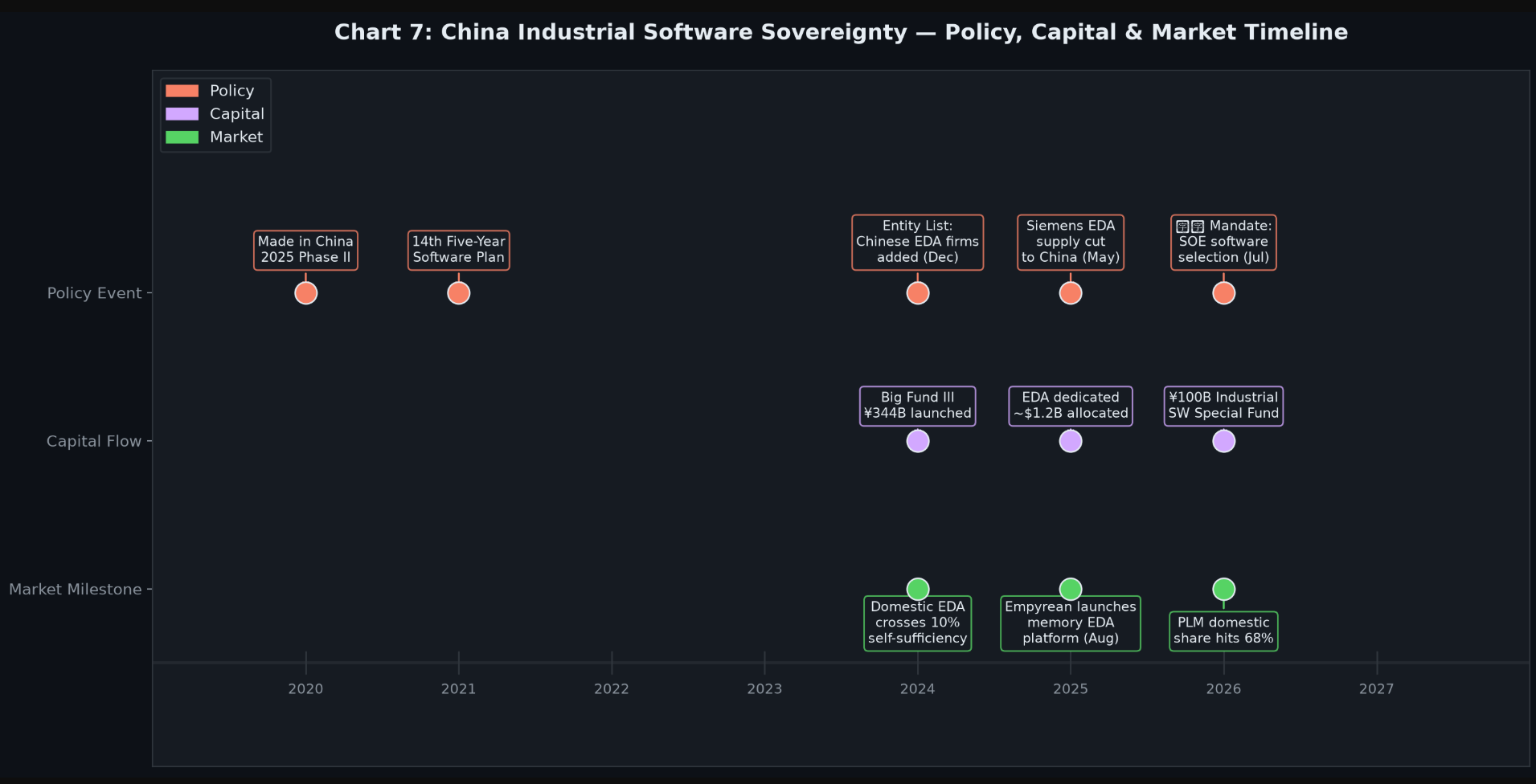
The net effect of this policy volatility: larger Chinese fabless companies now maintain formal EDA compliance programs; mid-tier companies accelerate "dual-track" EDA strategies combining imported tools for critical flows with domestic tools for auxiliary flows; and domestic EDA vendors benefit from structural demand tailwinds driven not just by performance merit but by supply-chain risk hedging.
2.2 The Capital Efficiency Problem
Here is the uncomfortable truth that no policy document will tell you: throwing capital at software sovereignty does not work the way it works for hardware.
In semiconductors, Big Fund money builds fabs, buys equipment, and subsidizes production lines. The relationship between capital input and capacity output is roughly linear — spend $10 billion, get a fab. In industrial software, the relationship is non-linear and uncertain. You can spend $1.2 billion on EDA and still not close the gap with Synopsys, because the constraint is not capital — it is three things that money alone cannot buy:
1. Ecosystem Depth. Synopsys has 35+ years of accumulated IP, process design kit (PDK) partnerships with every major foundry, and a user base that has filed millions of bug reports and feature requests. Empyrean (华大九天), China's EDA champion, has been at it for 20 years but still covers less than 40% of advanced node (7nm and below) functional requirements. The gap is not in the code — it is in the accumulated engineering knowledge embedded in the ecosystem.
2. Talent Concentration. The global EDA talent pool is estimated at 50,000-60,000 engineers. China has perhaps 8,000-10,000, with the top 200 concentrated in three companies. R&D investment rates tell the story: Empyrean spends 64.8% of revenue on R&D — the highest ratio in the global EDA industry — but this translates to roughly RMB 860 million ($118 million), compared to Synopsys's $1.9 billion R&D budget. You cannot out-spend a competitor who has 16x your absolute R&D resources.
3. Customer Validation Cycles. Industrial software is not consumer software. A CAD platform used to design aircraft engines must be validated across thousands of test cases, certified by aviation authorities, and proven in production over multiple product lifecycles. This takes 5-10 years per domain — regardless of how much capital is deployed.
The chart below shows the maturity radar for China's industrial software sovereignty across eight domains, compared to 2024 levels and the Western baseline:
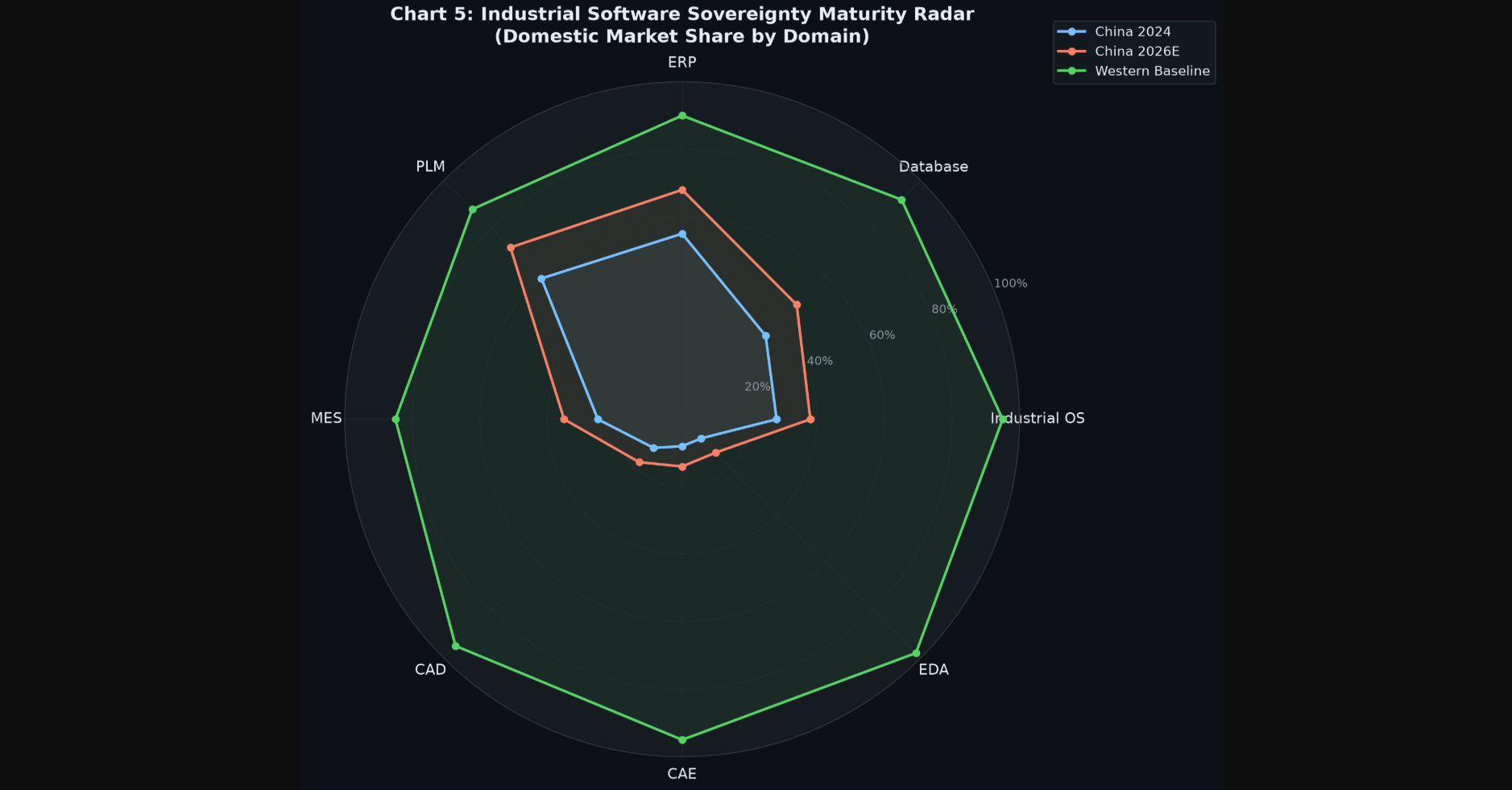
The radar reveals the core challenge: China has achieved parity or near-parity in domains where the technical complexity is manageable and the customer base is broad (ERP, PLM, database). But in domains where the technical barrier is extreme and the customer base is narrow (EDA, CAE, 3D CAD), the gap remains vast — and is closing slower than the headlines suggest.
Chapter 3: Domain-by-Domain — The Substitution Reality
3.1 The Substitution Velocity Index
Before diving into individual domains, it is worth establishing a framework for measuring substitution progress. We define the Substitution Velocity Index (SVI) as the annual percentage-point change in domestic market share within a given software category. An SVI above 5 percentage points per year indicates "sprint" velocity; 2-5 indicates "steady march"; below 2 indicates "stalled."
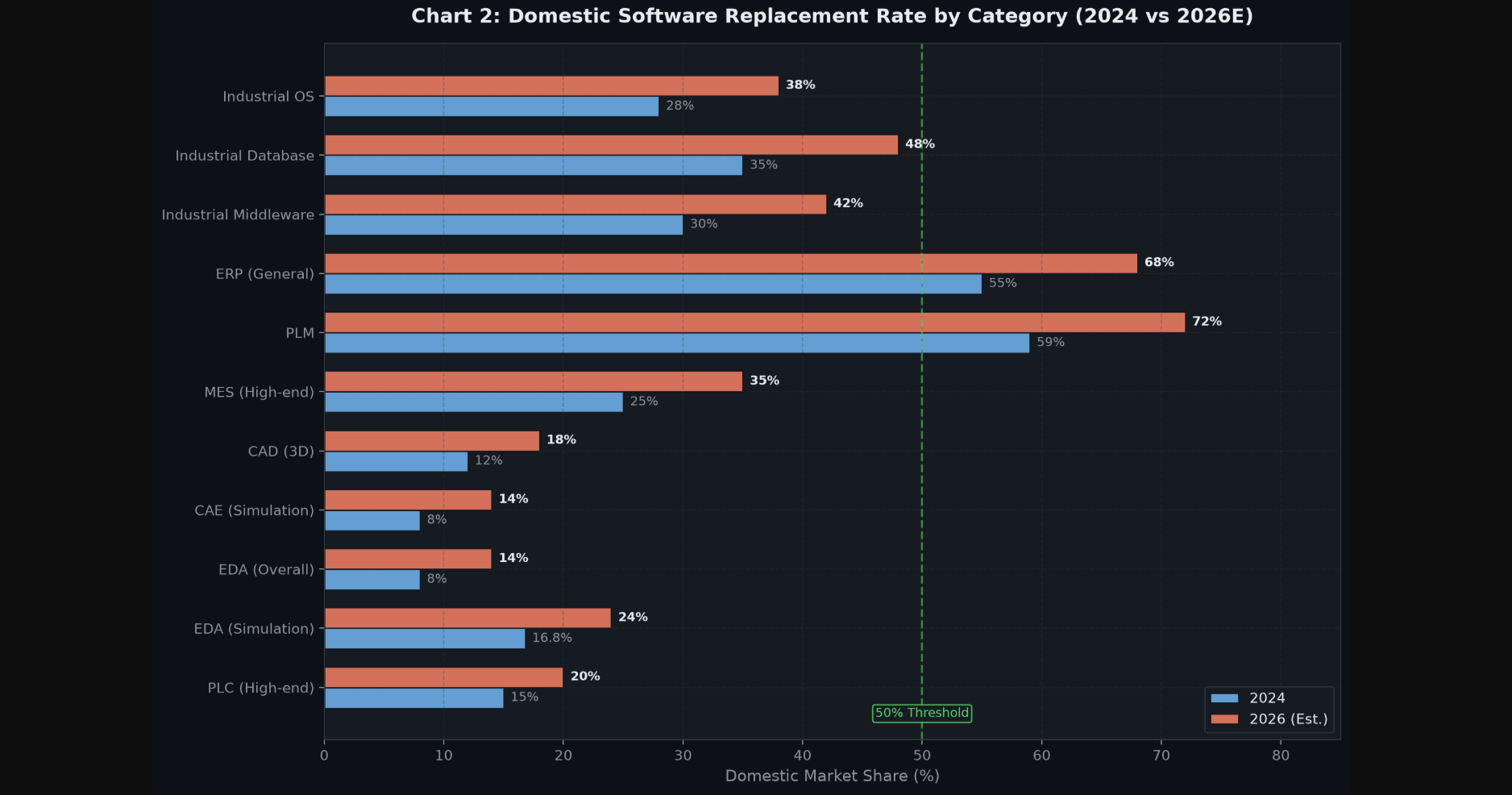
Based on the chart above, here is the SVI assessment for each major domain:
表格
| Domain | 2024 Share | 2026E Share | SVI | Assessment |
|---|---|---|---|---|
| PLM | 59% | 72% | +6.5 pp/yr | Sprint — domestic vendors winning mid-market |
| ERP (General) | 55% | 68% | +6.5 pp/yr | Sprint — Yonyou/Kingdee dominant in SMB |
| Industrial Database | 35% | 48% | +6.5 pp/yr | Sprint — cloud-native disruption |
| Industrial OS | 28% | 38% | +5.0 pp/yr | Sprint — HarmonyOS Industrial gaining |
| EDA (Simulation) | 16.8% | 24% | +3.6 pp/yr | Steady march — technical gap narrowing |
| MES (High-end) | 25% | 35% | +5.0 pp/yr | Sprint — but base is low |
| CAD (3D) | 12% | 18% | +3.0 pp/yr | Steady march — ZWSOFT making progress |
| CAE (Simulation) | 8% | 14% | +3.0 pp/yr | Steady march — deepest technical gap |
| EDA (Overall) | 8% | 14% | +3.0 pp/yr | Steady march — advanced nodes remain blocked |
| PLC (High-end) | 15% | 20% | +2.5 pp/yr | Stalled — Siemens/Rockwell moat deep |
The pattern is clear: China sprints where the technical barrier is moderate and the market is broad; it marches where the barrier is high and the market is narrow. The domains that matter most for advanced manufacturing — 3D CAD, CAE, EDA, high-end PLC — are exactly the domains where progress is slowest.
3.2 PLM: The First Victory
Product Lifecycle Management is where Chinese software vendors have achieved their first decisive victory. Domestic PLM market share reached 68% in the first half of 2026, up from 59% a year earlier — a 9 percentage-point jump that represents the fastest substitution velocity of any major industrial software domain.
The drivers are specific and instructive:
Xinchuang mandate as market creator. State-owned enterprises in aerospace, defense, and energy — historically the most PLM-dependent sectors — now require 信创-compatible PLM in procurement. This eliminated the default preference for Siemens Teamcenter and Dassault Enovia in the largest customer segment.
Dingjie (鼎捷) as the breakout vendor. Dingjie's PLM revenue grew 22.8% in 2026 H1, the fastest in the industry, reaching 6.2% market share — the first Chinese PLM vendor to exceed 5%. More importantly, this growth came from premium customers in automotive and electronics, not from low-end market displacement. Unit prices increased even as volume grew — a sign that domestic PLM is transitioning from "acceptable alternative" to "preferred choice."
AI integration as differentiator. Domestic cloud PLM vendor Zhicheng (智橙) integrated DeepSeek and Tongyi Qianwen LLMs in February 2025, launching AI-powered engineering knowledge bases and AI-assisted product design tools. This gave Chinese PLM vendors a feature that Western incumbents — slower to adopt Chinese AI models — could not match in the domestic market.
But the PLM victory has limits. The 68% domestic share is concentrated in mid-market and SOE procurement. In the top 100 multinational manufacturers operating in China — companies like Apple's Foxconn, Tesla's Shanghai Gigafactory, BMW's Brilliance joint venture — Western PLM (Teamcenter, Enovia) remains standard. These companies run global PLM systems that cannot be fragmented by market. The domestic victory is real, but it is a mid-market victory.
3.3 EDA: The Most Contested Frontier
If PLM is the first victory, EDA is the longest siege. China's EDA market was RMB 18.49 billion ($2.54 billion) in 2025, representing 18.1% of the global total. Three American/European companies — Synopsys (40.8%), Cadence (27.3%), and Siemens EDA (10.6%) — control 78.7% of this market. The remaining 21.3% is split among a growing field of domestic challengers.
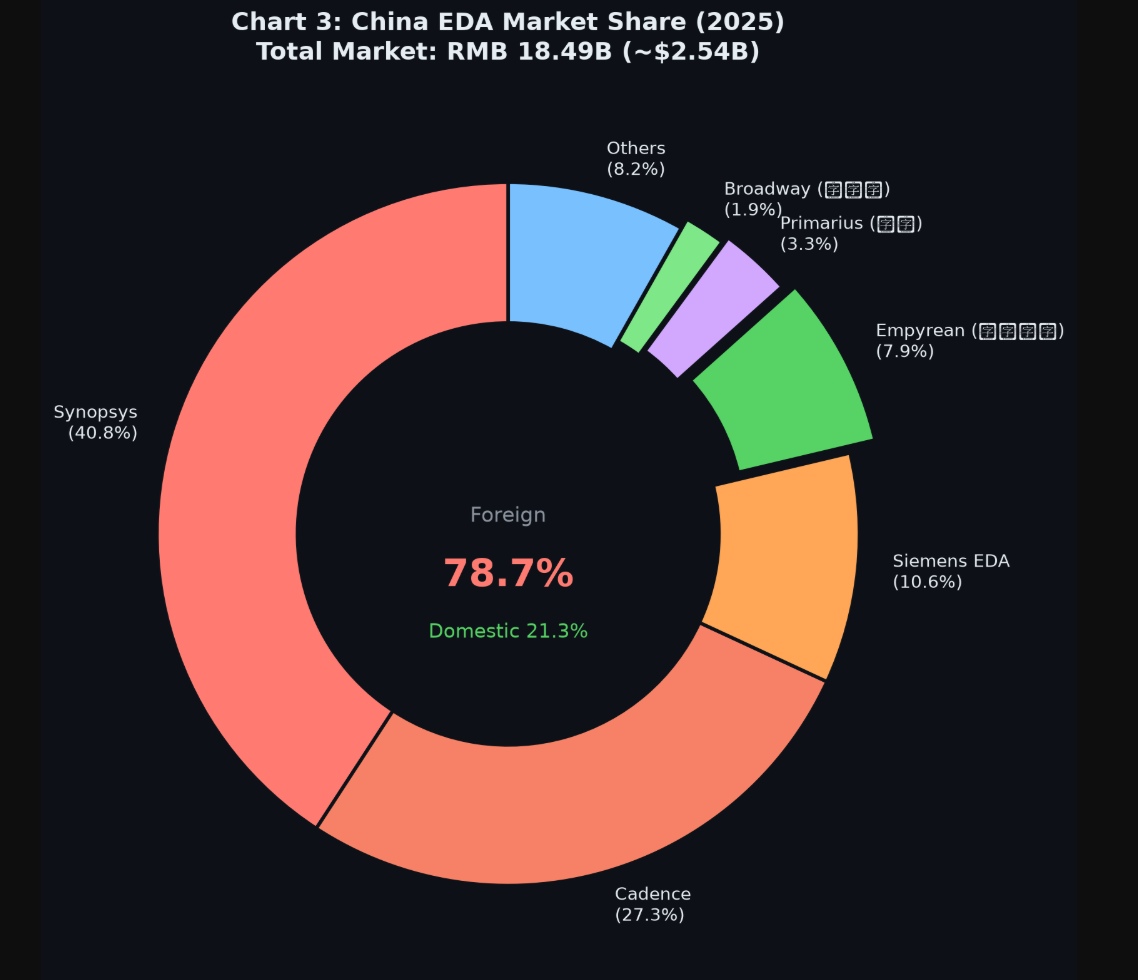
The domestic EDA landscape is led by three publicly traded champions:
Empyrean Technology (华大九天, 301269.SZ): China's largest EDA company and the world's fifth-largest EDA vendor. 2025 revenue: RMB 1.325 billion (+8.4% YoY). R&D expense rate: 64.8% of revenue — the highest in the global EDA industry, reflecting a strategy of trading near-term profitability for long-term capability. Key 2025 milestone: launched China's first EDA platform for memory chip mass production, deployed at CXMT (长鑫存储) for DRAM yield-quality validation. Empyrean's simulation market share reached 7.9% — fourth globally, first domestically.
Primarius Technologies (概伦电子, 688206.SH): Focused on SPICE simulation and memory design. 2024 revenue: RMB 419 million (+27.4% YoY). Its NanoSpice X platform delivers over 2x performance improvement for large-capacity memory simulation. Primarius is executing the same vertical integration strategy that made Synopsys's DesignWare IP business successful — acquiring AMS IP companies to build an EDA+IP platform model.
解锁后续 88% 内容
Unlock the Remaining 88% of Evaluations & the Decision Engine
The second half includes: a core solution cross-comparison matrix, a key parameter selection checklist, an implementation pitfalls guide, and a TCO & ROI calculator for mainstream approaches.
Get Your Custom Solution (View in Dashboard)